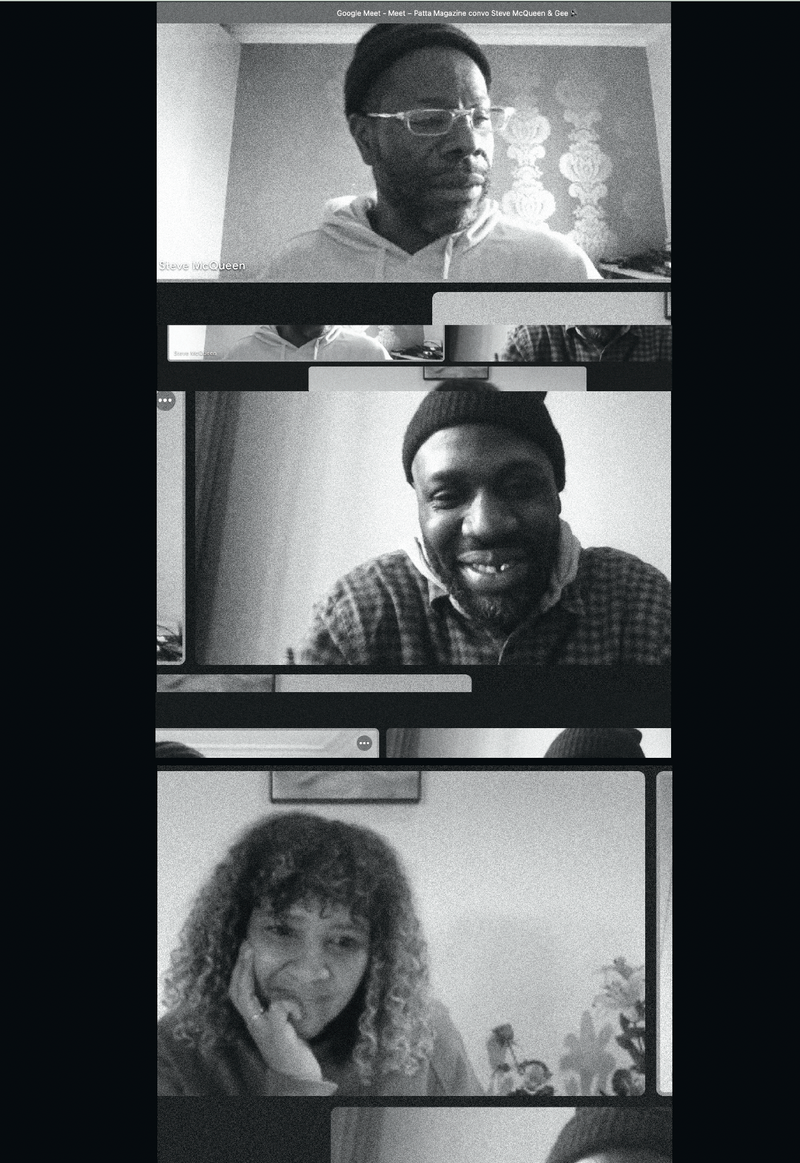
Words by Dominique Nzeyimana | Assistant: Immi AbrahamA big dream of mine is to be part of a frequent council that feels like a mix of stand-ups hanging out in bars after a late-night show and AA (for the mandatory sharing).We don’t all have to be best friends, but there’s big mutual respect. Every so-often, we’d congregate, and talk about what’s been on our minds; admit when we’ve been assholes , and celebrate each other’s wins. We’d also express love, exchange information and contacts, name figures, amounts, pitfalls, percentages, and laugh loud.. The small talk, while everyone’s trickling in, is “what did you eat today?”, “where do you get your jackets altered”, “how have you been sleeping?” and “which records have you been listening to?”. All before we also dive into building secure spaces, art shows, entertainment, alternate education, and specific care. Before we head out, “Does anybody need anything else?” has definitely been asked. Black bonding, but no one’s excluded except bigots. A couple of times a year, we would release a double vinyl carrying the best excerpts of what was said.For Patta Volume One, I feel like jotting down the most direct outline of my conversation with two people who have been instrumental to my growth these past years. So let me introduce Steve McQueen and Guillaume Schmidt, who, both in their own brilliant ways with their art and their deep thinking and conscientious execution, have been forging brand-new connections and possibilities in my brain and reality. Gifts beyond measure. If you haven’t had the pleasure, I am sure they will do the same for you, and this talk is a start. Beyond an unafraid chronicler of our collective and ancestral history, globally acclaimed British-Caribbean director-filmmaker, artist, producer, and screenwriter Sir Steve McQueen CBE possesses the uncanny ability to discern, unlock and carefully release emotion from his audience. The agony and ecstasy of Black existence reflected — often for the very first time — back at you, not like a cold mirror but like a heart-to-heart with someone who deeply understands and cares. In a career spanning 30 years, as the first Black filmmaker to ever win an Academy Award for Best Picture, McQueen has today moved far beyond institutional praise–though it has come thick and plenty in the shape of an Oscar, BAFTA, Golden Globe, NAACP Image Award, Turner Prize, a knighthood, Cannes Caméra d’Or, BFI Fellowship, and many more.Steve grew up in Ealing, west London, in a Grenadian-Trinidadian household. Despite educators misreading his many talents, Steve pushed forth, self-sure and tenacious, to study art at the Chelsea College of Art and Design in London and at Goldsmiths College, where film became his preferred medium. A later stint at the Tisch School of the Arts at NYU defogged a path to further creation through photography, sculptures and installations, and, naturally, film. His early work in the ‘90s ranged from transgressive shorts in black-and-white (Bear) to a Super 8 film (Exodus), which eventually landed him the Turner Prize in 1999. In 2007, McQueen made waves by unveiling an artwork honoring fallen British soldiers on stamps–daring the Royal Mail to take a stand. This thought-provoking work proved fertile ground for his feature-length films, the first two starring Michael Fassbender: Hunger (2008), on the last days of Irish nationalist Bobby Sands and Shame (2011), a sinewy story on sex addiction. Next, McQueen moved mountains to get his culture-shifting film 12 Years a Slave released. The unflinching story of enslaved free man Solomon Northup cleared the 2014 award season, receiving a Golden Globe and Academy Award for Best Picture. The following feature Widows (2018) was widely acclaimed for deepening the heist genre. In 2019, Steve created Soundtrack of America, a tour de force concert series feting the history and influence of African American music. In 2019 and 2020, both Tate and Tate Modern showed Year 3 and the major exhibition Steve McQueen spanning 20 years of McQueen’s work. More recently, McQueen co-wrote and directed the deeply influential anthology film series Small Axe (2020), centering the West Indian Windrush community in London through visceral vignettes. For this series, he collaborated with Patta on a limited 2021 Small Axe T-shirt and knitted jumper and produced the feted Patta x Nike ‘The Wave’ short film series with his production house Lammas Park. In 2022, McQueen’s Uprising documentary won the BAFTA for Factual Series. The list of incredible achievements goes on. For all his commercial and critical success, true iconoclast Steve McQueen has achieved one of the rarest feats in artistic life. He has arrived at that plane of visionary achievement that stands beyond critique and the white, Western gaze, creating a vault of timeless heirlooms and capsules of Culture.Guillaume Schmidt, known as ‘Gee’ to many and as ‘Gui’ to Steve, is the co-founder of Patta. Along with his business partner and best friend Edson Sabajo, he turned what was once a small sneaker shop and streetwear brand into an ever-evolving magnum opus, shifting culture and community as we know it. When Schmidt and Sabajo — who met working at record store Fat Beats Amsterdam — opened the doors of the first Patta store in 2004, energies aligned for the most successful Lowlands community brand ever to take root and bear fruit. Trial, error, and woes turned into wins, which organically grew Patta’s halo until it spanned an Amsterdam flagship and sought-after clothing line, a huge international fandom, London and Milan brick-and-mortars, a charitable foundation, an entrepreneurship Academy and summer school, a record label, a running team and much more. As an internationally respected creative, industry, and community leader, Schmidt has worked with just about every major name in the fashion industry; from Nike to Levi's, Converse, Puma, Tommy Hilfiger, Reebok, New Balance, Vans, Napapijri, Asics, Fila, Alpha Industries, Timex and many others. With Patta, Gee has had an unmistakable impact on how streetwear and hip-hop culture evolved from an underground phenomenon to a globally dominant culture. Crucially, Team Patta has transcended the success of their products and collabs by putting community, intersectionality, and culture above profit. It’s a level of care that shows in any interaction you could have with Gee, whether it’s face-to-face or through wearing Patta: he makes you feel seen, uplifted, and respected.By dragging banks and billion-dollar brands alike into their ‘pull up and give back’ philosophy, Gee, Edson, and the team have not only made sure we looked great in their sought-after collections for nearly two decades, but they are also doing more than their part in the imperative re-imagining of how we can be more of our authentic selves and break free from institutional and internalized restrictions. DOMINIQUE NZEYIMANA: “Thank you both for being here. I’m extremely nervous. My daughter and I went to see The Cure in concert a couple of days ago and we went to dinner first, and she asked me: ‘Mom, why are you so nervous? You talk about both of their work all of the time!’ And I said: ‘Yes, but not to their faces!’ “So, I’m honored. Gee, of course, you know I love you so much and I love everything you and Patta do, thank you so much for asking me to take this on. Steve, your work over the past couple of years, I don’t think anything has touched and inspired me more. I was on holiday this summer and I read your book on the beach and I had the best time, just sitting in the sun, exploring your work even further. “I would love to go back a little bit with this first question. Who, in your recollection, was the first person to instill confidence in you?”STEVE MCQUEEN: “Well, other than my parents, it was Simon Foxton. For people who don’t know him, he was one of the original stylists, along with Ray Petri, before the word ‘stylist’ was ever known. It was amazing meeting him. I was in Camden, with my friend, Danny, and we thought: ‘let’s sell food at the market here. You could sell second-hand clothes and food at Camden Market.’ “This was before vintage was called ‘vintage’; it was just second-hand. So, Danny and I were selling some stuff, and a guy came up to me with a phone number and said: ‘I’m Simon Foxton’s assistant, are you interested in doing some modeling?’ I said: ‘Huh? What’s that about?’ I didn’t know who he was, but Danny said: ‘Simon Foxton worked with Nick Knight, oh my god, you’ve got to do it, you’ve got to do it.’ I rang the number and, strangely enough, the first three digits were very similar to my three digits. Meaning that he lived in my neighborhood. Turned out Simon lived only 15 minutes from my house. 15 minutes. So, that was such a beautiful coincidence. “Anyway, I got to know him, we did a shoot, and that’s how I met Edward Enninful because Simon had spotted him too. That’s how our worlds collided. Simon is just beautiful, and was extremely helpful in giving me confidence. You know, in the house I grew up in, the only real book was the Bible. Going to Simon’s place, it just offered me situational possibilities. He was that person, and I used to go to his house every Friday. We used to watch TV and have a nice time just talking about things. He was just a wonderful person who gave me a lot of ideas. Just talking about inspiration. Not necessarily having the answer to anything but allowing conversations to develop. Still, to this day, he’s my best friend.” GUILLAUME SCHMIDT: “Was he also connected to Judy Blame?”SM: “He knew Judy, yes. We used to all hang out together. It’s London; everyone knows each other. Strange, but true.”DN: “I just read Edward Enninful’s memoir and I marveled at how closely connected you all were. When I first got the question if I wanted to sit in for this conversation, I told Lee Stuart that I was reading A Visible Man and that I was highlighting some pieces where your name came up, and that was even before I knew that I was going to be here today. And the parts where Judy Blame came up as well. Because, obviously, when Neneh Cherry came onto our screens in the late 80s, she made such an impact on me and I went out of my way to find out where she got her clothes from, and that’s how I also found out about Buffalo and Judy Blame. So now, to read in Edward’s book you were all within each other’s orbit, it’s amazing. Gee, I’m first going to ask you that question as well, who was that first person to instill confidence in you?”GS: “Definitely my dad. Both my parents are very inspiring to me, but my dad was the one to emphasize knowing yourself and being proud. My neighborhood was pretty mixed where I grew up, but then I went to do Atheneum which was pretty white. I was a rare sight at my school and things happened that sound strange now, like the touching of hair, very familiar. So, my dad was very protective in that sense of me not trying to be someone else but being proud of who I was and where I’m coming from. He is my inspiration. And then, of course, coming of age: Edson. To this day, our partnership blended into our friendship is something special. Since the early days of our company, he would take on the financial tasks so I could take on more of the creative–although he has talents in that arena himself. He knew the importance of us getting our business in order and sacrificed himself for me, although he would never put it like that. He also did that in a way that he was always the type of financial man–like: ‘Yo, if you think it’s a good idea, let’s fuckin’ do it.’ We failed, and we won sometimes, but even when we failed ten times, he was still supportive and always about confidence. Always: ‘Listen, if you think that is what we should be doing, I trust you, so let’s just go.’”DN: “In conversations we’ve had, this has come up, and you’ve used the word ‘sacrifice’ before regarding Edson wearing the finance hat. Do you feel guilty about this early allocation of tasks?”GS: “Hmmm, no, I don’t feel guilty. I think I have put my money where my mouth is. We’re not sitting here, having this conversation for no reason. But sometimes, it’s also good to acknowledge it. We could’ve both wanted to do creative stuff. I would say ‘the fun stuff’. I just think it’s very good for him to know that I know. I don’t feel guilty because I’m very good at the creative part. And whenever he asks, when deliberation is needed, I'm there from a financial point of view. But I mean that sometimes you have to see it, say it, and be aware of it.”SM: “I imagine Edson also acknowledged that you were better at one thing and he was better at the other thing. I think the acknowledgment, understanding, and appreciation of each other’s positions makes for a good partnership.”DN: “We’ll come back to the materializing of the work and some collaborations, but the second part of my first question is: what was the first place or space where you felt truly at home?”SM: “Amsterdam, to be honest with you. It’s kind of weird to say that. I always make a house a home anywhere I live. I never had a studio for work. The studio is in my head, and it used to be that my home was in my head. When I got to Amsterdam, I didn’t know anyone, and everything was unfamiliar. So therefore, I had space for myself. When I’m in London, I’m always on. There’s a certain kind of code of conduct, a thing that goes on subconsciously, and it’s exhausting sometimes. You don’t even know you’re doing it because it’s just how it is. So, when I got to Amsterdam, I discovered: ‘Oh, there’s another way of living; there’s another way of seeing.’ I had more time for myself; I had more time to reflect. And that was interesting. Plus, I’m a homebody. I love being at home.” DN: “How did you make your house a home? Without being too intrusive, is it through art that’s on your walls, special furniture? What is it?”SM: “I’m surrounded by a lot of books. Books are my thing. I just love being here with my kids and my wife. They’re not always home, but I love it when they are. I don’t have any art on my walls. When I was at art school, all my walls were white. Because if I had anything on the wall, it sort of infects thoughts. What else is home for me? It sounds funny, but I like to be warm. (laughs) I like to clean. I moved my vacuum cleaner, my Dyson, off-screen a second ago. It’s like nesting. When I come back from a shoot, I often annoy my wife because I end up cleaning. She will ask: ‘It’s not clean? What’s the matter with you?’ But it’s not that. I’m just making the nest again.”GS: “When I think about Steve’s home, I think about birthdays. As you know, I met Steve through our kids, his son and my son; they were in the same class. We were two dads on the playground, giving each other the nod. And the nodding became a cup of coffee, and the cup of coffee became ‘hey, come to my son’s birthday’, or ‘come to my birthday’. And just, from the gate, before really knowing him, I got to know his mom, his sister, his cousin, and I just had such an amazing time. It really felt like a home from the moment I set foot inside. That’s a special thing. And, also segueing into what he’s saying about Amsterdam… Originally, I came from a smaller city in the Netherlands and riding the train to Amsterdam in the late ‘90s felt like arriving at a big playing field. It was just such a brilliant city for me to come of age. I really loved the place from the get-go. And I still feel that way. It was also very much of a safe space for me. “Can I say a little thing about Steve’s hometown of London? That’s a city I fell in and out of love with. Sometimes, I really loved it, and sometimes, I really hated it, mostly depending on what I was doing there. It’s huge, which makes getting from place to place such a thing. I really had to get used to it, but I must say London (Notting Hill) Carnival, going there these past couple of years, totally opened my eyes. I’m so in love with that place now. I’m still buzzing from the energy I got there last summer..”DN: “Is that a feeling you can get in Amsterdam as well? Or is that really specific to London?”GS: “I’ve never been to Rio, or to any of those types of carnivals and celebrations. I’ve been to America, I went to Puerto Rican day parades, summer festivals, and all that type of stuff. Obviously, we have Keti Koti and Kwaku Summer Festival, but to be honest, I have never experienced something similar to the London Carnival in 2022. I’ve been there before. Maybe it was the space I was at in my head and what I had going on and all the COVID, Black Lives Matter, and all of these things that also very much occupied my head… But it was so much more apparent for me now; it really clicked. There are these conversations about why it’s still going on and sometimes people forget about the reason it was there in the first place. I think it’s so needed, and it felt so good.” DN: “Steve, London is your hometown; you grew up with this festival. And you’ve probably been to Keti Koti as well? GS: (nods) “Yes, he has.”DN: “Can you grasp the difference?”SM: “In London, Carnival is unabashed, and the style is ‘come as you are’. Also, there are older people, my parents’ generation who follow their steel band. Then there’s the mid-generation going for reggae, maybe, and the younger generation for grime or whatever it is they’re into. You have all these different generations who go there and enjoy themselves unabashedly. It’s a real process. It’s a street party, don’t forget it’s a street party. Meaning that there’s a situation; it’s a vibe. People get a sense of authority, a kind of brazenness, that they own the city. Unlike a party that’s enclosed, London carnival is a roaming situation. This is ours. We own the streets. “And very important to remember we missed the 50th anniversary because of COVID. So, when people came out this year, they came out and wanted to be seen. As Gee has said, a lot has happened in that time. George Floyd’s murder and Grenfell, five years prior. People wanted to be seen and heard. There’s just a celebration. My friend said to me: they’ve got every Saturday with their football, we’ve got two days in the year, let’s go for it. It’s about being celebratory, about owning it, about being sexual, having fun. It’s about being unabashedly you. Extraordinary.”DN: “I was wondering Gee, in the beginning of you two knowing each other, did you talk to Steve about his work?”GS: “At first our relationship was purely getting to know each other, really. A cup of coffee and some small talk. Over time, you also start talking about what interests you. If you like someone and know that they created work that you love…” SM: “Can I jump in here? I had no idea who this guy was. This tall, dark-skinned, handsome Black guy is waiting for his child. I gave him a nod, here and there, and that was it. Obviously, our sons hung out, so then, they brought their parents in, and we got to meet. So, up until a long time, I didn’t know what Gee did. I didn’t even know what Patta was. I saw it around, and then: ‘That’s you, Patta? Oh, okay.’ We got into a conversation, all very organic. I wasn’t looking for him; he wasn’t looking for me; we just found each other. That is the beautiful thing about our relationship, really.” GS: “I cherish the way that we bonded. To Steve’s point, it was very organic and very much about us and the relationship. Then we started talking a lot when Trump won the election. The day before it was final, we were talking to each other saying: ‘This is not even possible, man! The world will be upside down if Trump becomes president.’ And then, next thing, you come to school and Steve just looks at me like (makes dramatic side-eye) ‘What a nightmare.’ Crazy.”SM: “I will never forget waking up in the middle of the night. I was so selfish, I thought: ‘Whyyy? Why me? Why do I have to live through this?’”(Everyone laughs)SM: “It wasn’t even about my wife or my children. Just why me?” (laughs)GS: “And you weren’t even living in the U.S.!”DN: “So, Gee, Small Axe came out. Did you immediately think: ‘We have to do something together?’ Or how did that happen?”GS: “Again, very organically. I was incredibly compelled that he was doing something so democratically available. For a theatrical release, you have to go to a cinema. You have to pay for the ticket. You have to make an effort. But the fact that he wanted it to be on national television, the BBC, and that it becomes so democratic and that it actually can be watched by an entire nation so to speak, I found that amazing. “I watched Lovers Rock again with a friend last Friday, because I have a really nice sound system in my house. And she said exactly what the movie and Steve’s idea was about: ‘I’ve never seen this. I have no recollection of mostly or all Black people being captured on film in this manner.’ There are all these references of white people partying and having a good time. There are a gazillion references for that. However, even what was captured for Lovers Rock and all these other little-known stories, he wanted them to be accessible to as many people as possible. “That thought process and those stories are so important. And I just thought that it was imperative for us, and for Patta as a brand, to support in any way we could. We want our DNA and the people that follow us to know that this history exists and that they need to spread the word. I would say that it is a secondary mission for me to let as many people know about Small Axe as I possibly can.” DN: “I think, on my podcast, it’s the most recommended piece of work, I yell it at everybody. ‘Have you seen this? Have you not seen this?’ waving my box set at them. (laughs) As soon as someone talks about music or loving movies, it’s top of mind. Always. From the moment I saw it. And, for me, out of all the films, they all touched me, but the two that touched me the most were Lovers Rock, obviously, because of all the details–the getting ready with friends, the love story, the music, the nuanced characters, the style, the dancing, the drama, and suspense. The first time I watched it–of course, I was waiting for the other shoe to drop because that’s kind of what we learned as Black people seeing ourselves on screen if it goes too well for a long time, you think: when is something really bad going to happen or when is someone going to get killed? And in the end, there’s an interaction where someone tries to put the protagonist in his so-called place. And then, I watched Education—I followed the chronology Steve set up for the BBC—and when the credits started rolling, I just sat there and really bawled my eyes out. Just like Gee, I went to a super-white Catholic school until I was fourteen and I was the only Black girl the entire time. My headmaster was a nun that entire time, plus I had a nun for a teacher for a whole year. Watching Education, it was the first time that so many things that I felt were acknowledged. I knew it all happened, but this was the first time I saw it emphasized on screen. That shifted and lifted something inside me. So, thank you so much for that, Steve! Can you talk about what making Small Axe did for you?”SM: “My pleasure! I made four movies before I did Small Axe – Hunger, Shame, 12 Years a Slave, and Widows. Many people asked why I didn’t make it in the beginning, and honestly, I didn’t have the life experience. I wasn’t ready yet. And it’s only because of getting older, I can look back at what that timeframe was, what that time was about. Particularly Education was based a little bit—obviously not exactly—on my education. It’s so interesting all three of us talking about our education, it’s very noticeable how it was traumatic for all three of us in one shape or another. For a long time, I didn’t want to reflect on that. “The only reason I’m here talking to you is because of Black people and what they did to reverse the system. Because, if anyone hasn’t seen the film, there’s a situation where a lot of Black children are being put in this section, and they call it ‘Educationally Subnormal’. If you were deemed ‘educationally subnormal’, you got put in a special school. And that would have happened to me, if it wasn’t for those Black parents and the Saturday schools formed in the UK through them. “Black parents fighting the school system to say: ‘this is not right.’ And it’s very important that we, as Black people, govern ourselves to change and reverse the law so children can fulfill their potential. Because, if that hadn’t happened, I would’ve been in a ‘subnormal’ school, no doubt.”DN: “Did making Education resolve anything for you?”SM: “It was part of the process. For a lot of people, the damage that is done in your early education can be like a ball and chain. The self-doubt and lack of belief in oneself can linger. I was very lucky, similar to Gee, with my parents and the people around me. And also, I was cocky. I thought I was the best. Even if people thought I wasn’t, I thought I was the best. Absolutely.”DN “Me too. You have to.”SM: “But I really believed it. (laughs) In some ways, you’re quite right, you have to. But to be in the situation to have done what I’ve done, and to have had teachers and other adults telling me I was stupid. I just knew I wasn’t. I really knew. It wasn’t a case of false faith; it was a case of: I know I have the capability of doing this. That came from my parents, for sure, no doubt about that.”DN: “Do you have a reaction to that, Gee? How was watching Education for you?”GS: “It manifested a lot of things that should be very common for me but are uncommon. In every movie, I saw similarities, but what stayed with me the most was that I had never actually seen it as much on-screen. And I’m a movie buff, I watch a lot. But overall, I loved all the movies, for the resilience and people not taking what they were being served. Whether it’s the buff guy in Lovers Rock that comes outside to protect this girl that’s going into a dangerous situation, or it’s the parents and the Black women standing up for a kid. Watching these films, I learned a lot and I have a really special place in my heart for them.”DN: “Same here. Steve, you have been rightfully so bestowed with countless awards, accolades, and prizes. I was thinking about Kara Walker, she got the MacArthur Genius Grant and she later said in an interview: ‘I didn’t use it enough as a shield’. That struck me. Is there one out of all of your prizes, titles or awards that means the most to you in the sense that it lets you do things, it gives you more freedom?” SM: “Well, you know the fact that I won the Oscar for ‘Best Picture’ and I was the first Black director and first Black producer ever to do that–that means a lot. But at the same time, it’s as Miles Davis said: ‘So what?’ Because, honestly, I do not want to be judged by white people. And most people who judge these things are white. So, yes, it did allow me some access and as far as history is concerned, in movies, that is undoubtedly very significant. But, at the same time, so what? It’s about the work. It’s about what you produce. Who is this person saying it’s good or it’s bad? It’s the same person at school, telling me: ‘Steve McQueen, you’re good or you’re bad’. I must judge myself, on myself. And your peers, the people you respect and the people you hold up high. Those are the people I’m most interested in having conversations about what they think, rather than anyone else. “I remember while making 12 Years A Slave, someone close to my camp kept talking about ‘your impossible movie’. They said to me: ‘Movies with Black leads don’t travel abroad, don’t make any money abroad, they fail. Black movies don’t do anything but a little domestic box office in America, nothing crazy.’ Of course, 12 Years A Slave changed that completely. In the first two weeks, they only put it out in a hundred or even less cinemas. And people were knocking on the door asking: ‘Where is 12 Years A Slave?’ So, then they released it to 2,500 cinemas. We lost over 20 million in our first two weeks because they didn’t believe it would do well. In its first week of DVD sales in America, it sold over a million copies. In its first week. I only just found this out.” GS: “Over a million DVD’s in this day and age.”SM: “This is when people used to buy DVDs for $20. I never saw any of that money, by the way. People were saying: ‘White people will be too afraid to go to the cinemas to see 12 Years A Slave. And then in one week, we sold 1 million DVDs.”DN: “What do you do with that information, because you don’t seem angry or frustrated at all?”SM: “Sometimes you just have to break the mold. I know for a fact that without 12 Years A Slave; Moonlight, and Selma wouldn’t’ve been made. I know this because the same producers couldn’t get it made. After 12 Years A Slave, they did. Now the thinking became: ‘Black movies make money? Okay, let’s get this out’.” The trajectory goes all the way to Black Panther. And I know that if Obama wasn’t the president, 12 Years A Slave wouldn’t have been made, at all.” GS: “Wow.”DN: “Have you been able to tell him that?”SM: “I was invited to the White House because of 12 Years and we met and he said congratulations and all kinds of lovely words. He was very gracious and did talk about the movie, but no, I wasn’t able to tell him that. A lot of things happened because of him, absolutely, there’s not a question about it.”GS: “The importance isn’t about what you think about what Obama did as president, or even what your opinion is about 12 Years A Slave. It’s about the possibilities it creates, just by existing.”SM “That’s what I’m most proud of, I’m very happy and excited about 12 Years A Slave and what it did and was. People were talking about slavery for the first time in a very interesting way. It wasn’t really spoken about. You go back to 2013, look what has happened in those ten years – things changed completely. Thank god.” DN: “Yes, thank god. I hope it keeps going and that the momentum for ‘Black films’ or for Black people getting the opportunities to make their art, to be at the forefront, continues that way and there isn’t another halt like there was in the 80s.”SM: “Indeed. Gee said the word ‘sacrifice’ very early on and I really believe that what happened during the pandemic and what happened with the murder of George Floyd is representative of that. We Black people have to deal with extremes. The fact that George Floyd was murdered in such a horrible, heinous manner in front of the world, during a pandemic: an earthquake has to arise before there’s an advancement in how we are treated. A lot of things happened after that moment, but do you see what we continuously have to sacrifice? A death in the most brutal way and a pandemic before people thought: ‘You know what? Maybe there’s something about this racism thing.” (shakes head)DN: “We go through this as adults, I just hope that our kids who went through the same thing get to process this in a healthy manner.”GS: “I’m hopeful. We’re all here, we’re working on it. I can’t be sorry about nothing; I can’t dwell on things. I got to move and get shit done. I don’t really wake up on some activism tip; I just do my things, I do what I love and what I like. I put music on, I go outside, and do creative shit. And, obviously, that is really empowering. I think that’s also something that came out of all the things that happened during COVID, the global rise of ‘Black Lives Matter’ and the aftermath of the murder of George Floyd, which is the empowerment of each other. When we were talking about the Nike commercials for ‘The Wave’ I called Steve not knowing whether he would like to do it because it’s definitely not something he’s said ‘yes’ to before. How we approached making those films together, giving space and opportunities to our Brothers and Sisters, people who are trying to do things, is the main takeaway. Getting together, establishing things together, applaud even if you don’t like a specific work. In the white man’s world, it’s very normal to have multiple perspectives and opinions, but it’s very important for us to be able to listen to each other and voice our thoughts and still say: ‘Whatever happens, yo let’s do this thing, let’s push’. Small Axe brought forth the opportunity for us to design a T-shirt and a jumper, and for Steve then came a chance to do something with a company he really likes. And it’s this Nike project and now even doing this interview and recognizing and seeing possibilities in each other, that is incredibly important. This could all be done on a much, much higher level. And don’t forget: you can vote with your wallet. If you don’t trust politicians, maybe leave the Louis Vuitton bag for once and buy a Patta hoodie or a Daily Paper shirt, or shop at Union or whoever you want to support. That’s awareness. That’s what a case like this is also showing.”DN: “I love that about you, Gee, and about Patta as a whole. I felt very early on that this was so much more than a brand and you all have proven that afterwards with Patta Academy, Foundation, Running Team and so on. Even just the expansion of the company, the stores and seeing all the ideas come to life. It gives me so much joy to witness.” GS: “You know what the thing is too? I just love people who can do things at the highest level. Regardless of color. I just like creativity. So yes, of course, I want to work with Steve because he makes incredible stuff that I adore. Making these choices and getting these ideas out, I really deem as super important.”DN: “Steve, have you heard about the Patta retirement home?”SM: “No, what is that? Gee, what have you been up to, what’s going on?”GS: “I’m not retiring. Edson has been talking about: ‘We materialized Patta Academy and now there’s another thing I really want to do: a retirement home for our people.’SM: “That is so brilliant! That is so good. I was thinking about that–maybe not what you’re doing, but is there a Black retirement home? Is there a place to go? And I couldn’t think of it. That is so beautiful.”DN: “And the best thing is, we can keep working and be mentors and still do our stuff!SM: “That’s very important. That’s so beautiful. Just to educate about Black health in general is so very important. And I think, again, people work so hard to do what they have to do, and I think this is a wonderful idea: just to look after these people who are our pioneers.”DN: “So, Gee, can you tell Edson that we’re coming?”GS: “A couple more spots filled.”SM “Seriously, are you doing that?”GS: “You know what, it’s on Edson’s mind and the same happened with his idea for Patta Academy. Our parents are getting older and we are getting older as well. I’d love to create a place where there is room for different interests beyond sitting around and playing bridge.”SM: “Interestingly, I was filming at a few retirement homes as I was doing a documentary in Amsterdam and I was just thinking: where are the Black people? Where are they?”GS: “Probably in family’s houses or family that come to their house to care for them–that’s what happens most of the time in these cultures. Sometimes, there’s also a budgetary problem. But it’s the same as with Patta Academy. When resources open up and you can get specific ideas executed, you can pull up for older people. We have to take care of the next generations to come, but we also can’t forget about the people that created space and made the ground fertile for us to build on.”DN: “This is excellent and I’m so honored to have had this conversation. My heart is full, it was amazing. Is there anything that you feel like you have to add?”SM: “I think it’s a perfect ending because we started with us discussing who inspired us as children, we talked about our childhood and our adulthood and dealing with the pasts of these institutions. To end on this beautiful note of these old people’s homes is fantastic. It’s a full circle. It’s something that often gets neglected, so I’m very inspired and touched by what Gee said.”GS: “Thank you for this. You know, when I reached out to Steve months ago: ‘Steve, we’re going to do this magazine.’ He said: ‘That’s brilliant!’. I went: ‘I really want to do an interview with you and somebody else, it can be anybody. Who would you like to talk to?’ And I gave him all these names. And he said: ‘I want to talk to you! Let’s have this conversation with you and me’. I was like: ‘Oh my god, but we can pick anyone on the planet’. And he said: ‘No! I’ll only do it with you’.”SM: “That’s typical Gee, I don’t think he knows how influential he is. I think that’s great. Sometimes I say: ‘Do you know what Patta is?!’ Before I finish: I went into the Patta store in London and I bought some stuff for my son. We were leaving the store and I had two bags. We went to this other store, just to buy some trainers and I was talking to this lady and she said: ‘You’ve just been to Patta? Aw, I love Patta. I love that store, it’s amazing, it’s really, really good. But I can’t afford it.’ When we were leaving there, I had an extra cloth bag, and I said: ‘Look, have this.’ And she was so touched. And she gave us a discount.”GS: (laughs)SM: “That’s the impact you are having. It’s the philosophy around the brand and people are obviously attached to it, so congratulations. That’s why I wanted to talk to you, you’re that significant.”