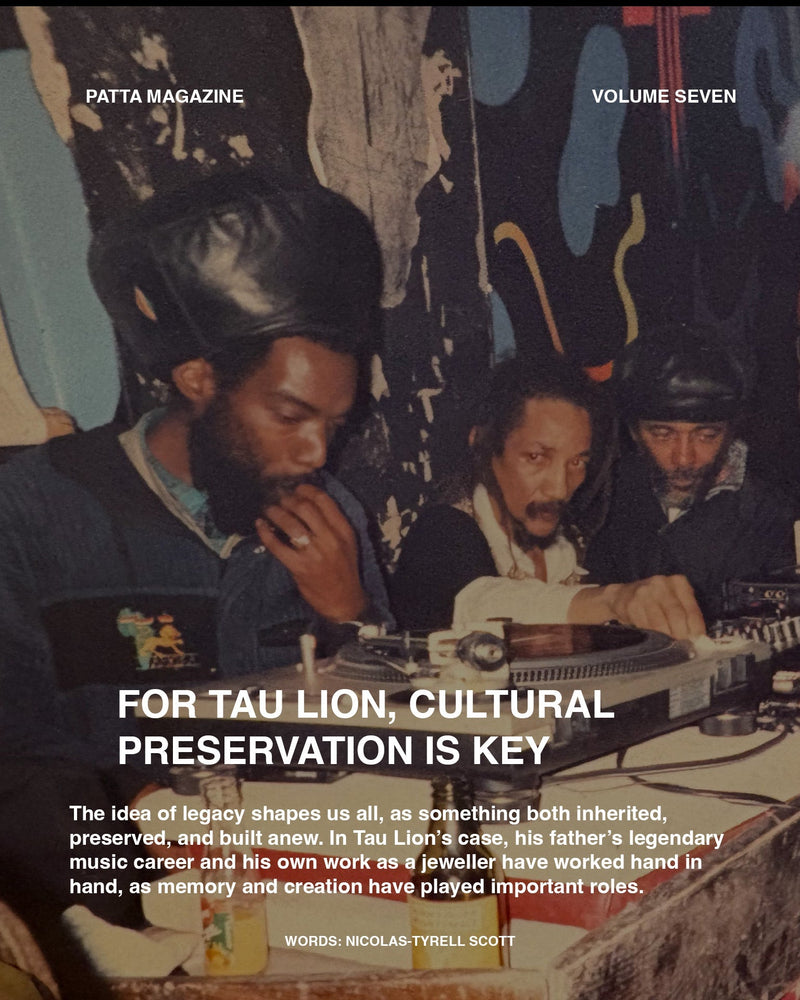
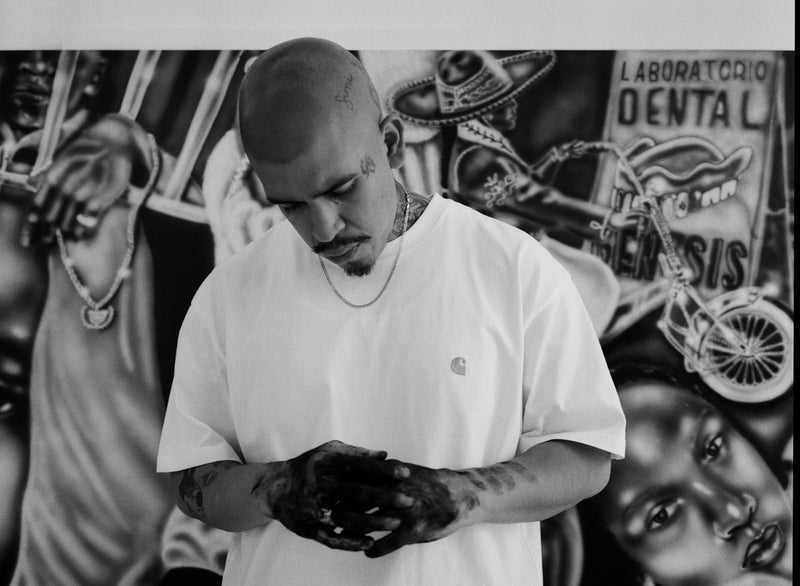
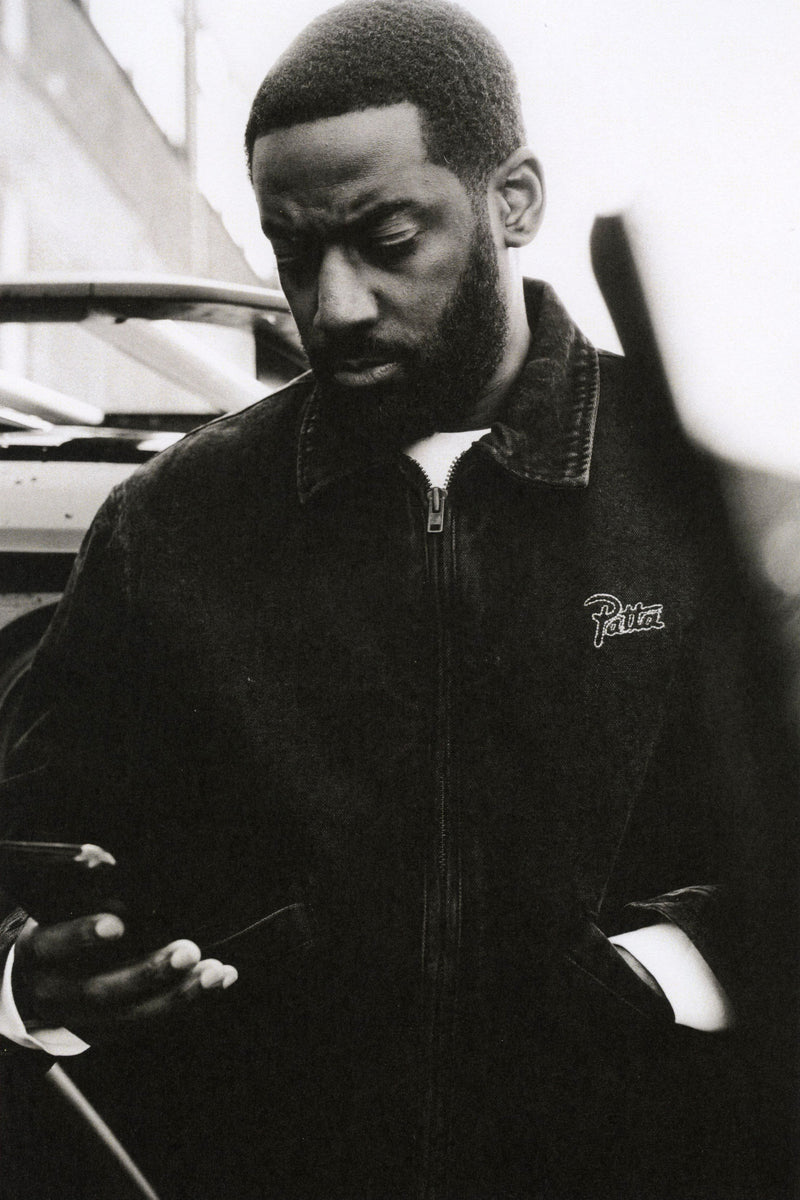
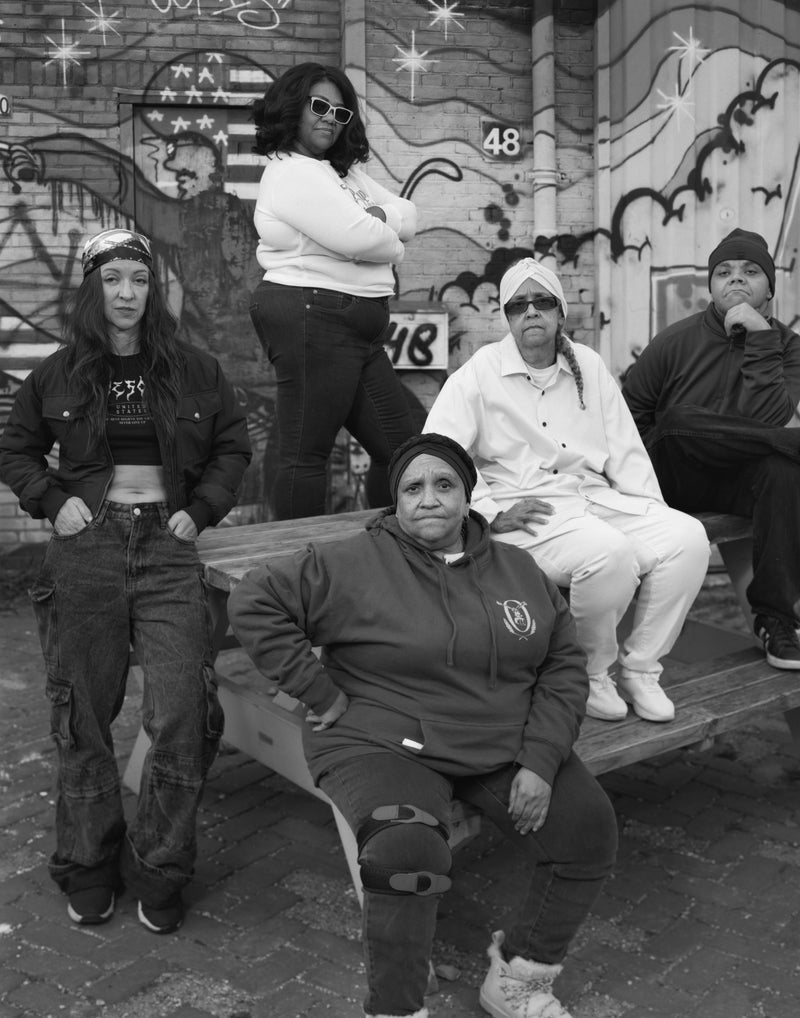
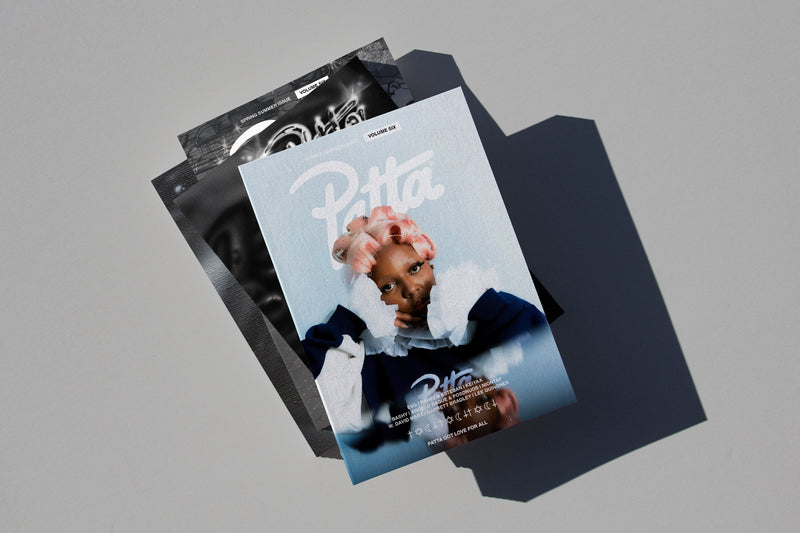
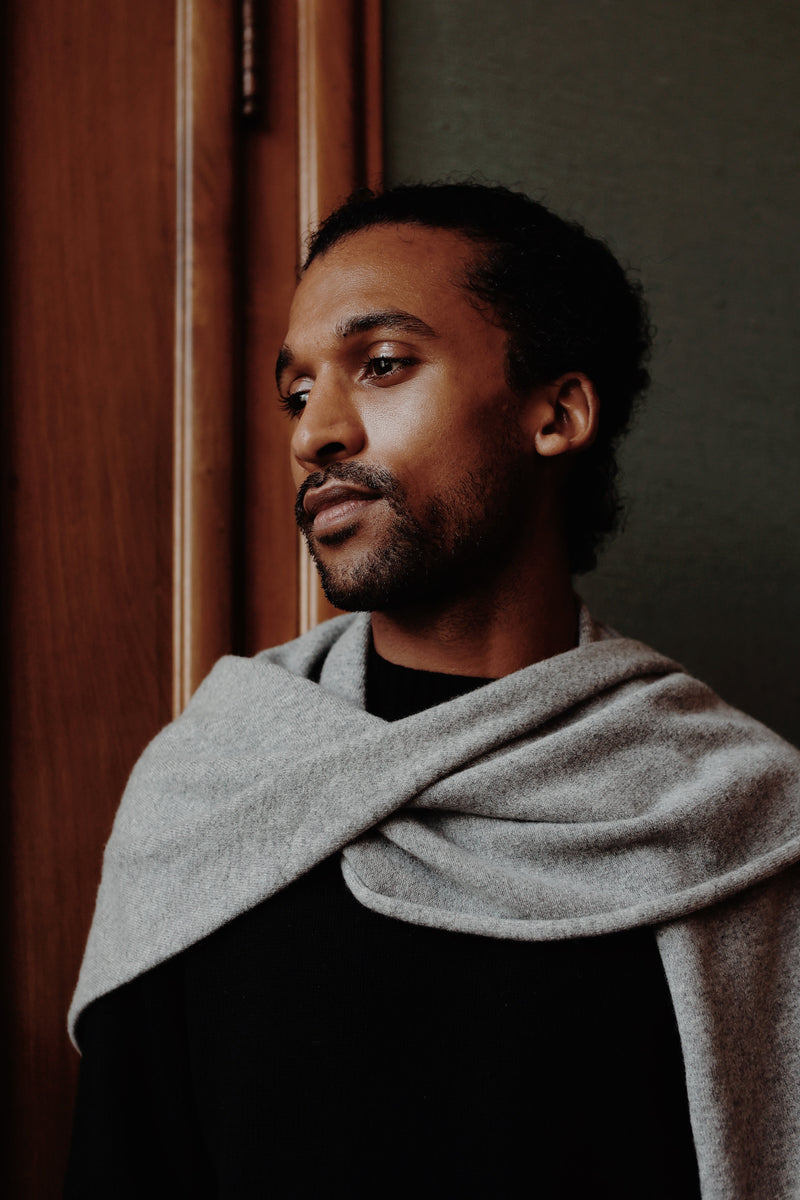
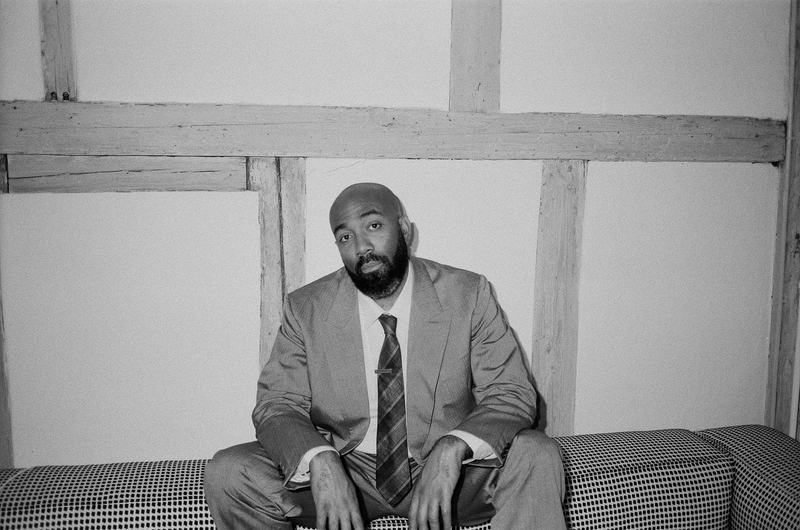
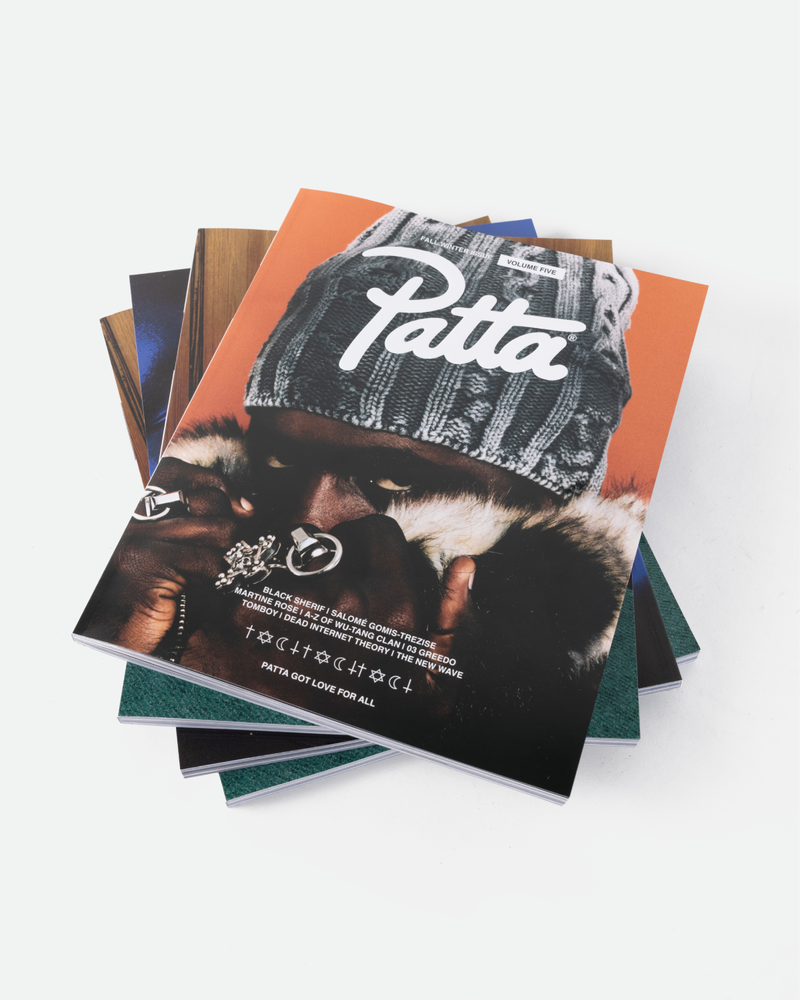
“I just played City Splash [festival],” he says eagerly, reflecting on his performance 24 hours ago. “It’s about 30,000 people there. I played the small stage, but you feel that collective energy, it’s crazy.” After inheriting the prolific London-based sound system Jah Youth from his late father, Allan Rolle, the 44-year-old is eager to preserve its legacy. Dedicated to roots reggae since its 1975 debut, the sound system has been entertaining intergenerational West Indians and Brits for over 50 years. “My father was a very inspirational person in and around the community,” Lion states. Using his compensation for an injury whilst serving as West Ham United’s U21’s league goalkeeper, Allan Rolle inspired Lion throughout his childhood, his ear for music expanding because of his father's pivot. “He even opened a record store in Upton Park,” Lion shares. “Because I looked so much like my father, musicians would stop me asking about it, my father, and the music in there.” Being of Dominican and Vincentian descent, Tau Lion was nourished by the strong, post-Windrush generation of West Indians who sought communal connection, collaboration, and celebration, Rolle’s ventures becoming integral to this collective yearning. “Both the record store and sound system became community hubs; it really gave my upbringing some excitement.” Jah Youth wasn’t just a success nationally, carrying on a legacy of sound systems in the country since 1955, but it made inroads into the wider Black diaspora, Lion gaining first-hand experience on tour, as the sound system made its way to various countries in Africa. “Suddenly, in 1990, we got to tour with the full sound system, we went to Kenya, Tanzania, and Zimbabwe,” Lion explains. Joined by the prolific band Misty in Roots, in Zimbabwe, Jah Youth supported a segment of their East African tour, aligning with the political message of Pan-Africanism. Here, Tau Lion was exposed to a bird's-eye view of politics and music's inherent overlap. “At that time, Misty In Roots were eager to extend their message out there, because apartheid was still an active situation.” With songs such as “Ghetto In The City” and their advocacy of the 1976 Rock Against Racism movement, Misty In Roots weren’t shy in using music as a vehicle for social change. “It was inspiring to see something like that up close and personal,” Lion notes. Grateful for the experience, he says the tour served as an important catalyst for his inter-communal efforts as an adult. After moving to Sierra Leone in 1991, Lion and his family were forced to return to London when civil war broke out. “I remember thrusting all we had into the back of the car one morning,” he recalls. “I couldn’t go back for some of the things.” Making it back to the UK safely, he would finish his final year of primary school before spending his secondary school years and college life, toying with the idea of returning to Africa. “I finally told my dad about it, but he wanted me to finish my education first.” Towards his late adolescence, however, he’d get the call, again via his father’s record store, to explore a new medium. “A jeweller, Gully used to shop at my dad’s store,” Lion explains. “When I was 19, he asked for my help. His jewelry brand was called Gullcano, so I jumped at the chance to dive into something new.” Focused on luxury chains and bracelets made in styles such as Cuban links, Tau Lion dived into the experience wholeheartedly, eager to gain a first-hand skillset.Quickly getting on with Gully, Lion would spend his free time assembling the jewellery. Formalising his knowledge academically, he later enrolled in college and university to study the art form, still working with Gullcano in the background. “I actually dropped out of university before final year, as I wanted the knowledge, not a formal academic paper,” he laughs. Eventually finding his way back to Africa, Lion purchased a house in Tanzania, with his father's backing and support, attempting to build a jewellery imprint of his own, dubbed Made In Africa. Expanding into beaded jewellery with local assemblers, Inter noticed a gap in knowledge on the ground. “There are transferable skills that I wanted to give people, helping them to expand,” Lion shares. Now, he goes back each September to run workshops, maintaining ties with his Tanzanian community. Tau Lion is bringing his expertise to Patta for a brand new jewellery collaboration set to showcase his years of work and practice to a new cohort of cultural enthusiasts. “My designs are inspired by ancient architecture and geometric design,” he begins, deep in thought. “For example, one of my links is inspired by stars, the other, planets, and the third, interconnected universes.” Deciding to focus on sets for both men and women, the bracelets crafted can be paired as a necklace. For Lion, the concept for the collection is tailored to the community, allowing for braces to be worn as individual pieces or assembled for multiple family members or friends. “Three [individual] bracelets will be able to assemble a standard male-sized chain, and two will be big enough for a woman,” Lion explains. Using the analogy of a father, he expresses that a necklace could become an heirloom for his child as they grow up. “It’s about keepsakes and legacy.” Made from sterling silver, Lion wanted an ethical, widely accessible material for the inaugural release, but also one that’s ideal for being worn in event spaces. Lion notes that some people believe sterling silver helps ground the body in high bass environments. “That’s where the connection between the sound systems and my focus now on jewellery collide too,” he continues.Mindful not just of this collection, but also what lies ahead, Tau Lion’s mission across sound and design is simple. For him, cultural preservation is key. “I’m just excited to carry on the legacy my father carried so strongly,” he says. “And creating and preserving my own at the same time.”Patta Magazine Volume 7 available soon
Art
magazine
+1
Anthony Gallery for Patta Magazine
Anthony Gallery for Patta Magazine
Words by Chris DanforthChicago’s Anthony Gallery is taking its distinctive curatorial vision across the Atlantic with the opening of a new space in Amsterdam. Founded by Isimeme “Easy” Otabor in 2019, Anthony Gallery is known for pairing buzzing and established artists, fostering cross-cultural dialogue, and reflecting Otabor’s personal perspective. Now, Amsterdam has become its second home. More than a gallery, the Amsterdam location aims to be a cultural hub, integrating music, design, and community engagement while connecting local and international artists. Otabor emphasizes that the gallery’s goal is to foster dialogue with Amsterdam’s creative ecosystem, not impose an outside voice. The launch features a collaborative exhibition by Tony Lewis, whose observational drawings capture human connection, paired with cocktails inspired by his work. Looking ahead to 2026, the gallery will host solo and group exhibitions blending local talent with global voices, creating a space that is both globally connected and locally rooted. Below, Patta Magazine chats with two of the minds behind the project, Easy Otabor, and supporting the project from Amsterdam multidisciplinary agency Tree Filling Window, Erum Shah.How did the relationship form between Chicago and Amsterdam?Erum Shah: I’ve worked with Easy for years, including on Tom Sachs projects. Easy has been thinking about expanding Anthony Gallery to Europe, and Amsterdam felt natural. Both cities are local yet global, with strong communities and a commitment to craft. Amsterdam, like Chicago, brings together music, design, and art in a way that aligns with Anthony Gallery’s values.Easy Otabor: Amsterdam has long been a crossroads for art and ideas — a place where conversations can take root. There’s a growing energy here around contemporary art, and we wanted to be part of that momentum while also creating a bridge between European and American audiences. You’re launching with Tony Lewis, tell us how that lined up.Erum Shah: We wanted a celebratory launch before the program officially kicks off in 2026. Easy has a long-standing relationship with artist Tony Lewis, whose drawings capture hospitality and human connection. He sketches in bars, observing people and spaces, which reflects the spirit of the gallery. The launch exhibition felt like a natural way to bring Amsterdam together while connecting US and European perspectives. Tony also plans to create cocktails to pair with his drawings, creating an interactive and authentic experience.Easy Otabor: We’ve admired Tony’s practice for years. His ability to use language to address questions of identity and communication feels incredibly relevant right now. When the opportunity arose to collaborate on a new body of work, the timing felt right for it to anchor our opening. It sets the tone for the kind of dialogue we want the gallery to fosterWhen you select artists to work with, what do you keep in mind?Erum Shah: Easy pairs new voices with established ones, challenging what fine art can be. He prioritizes cultural crossover and, as a Chicago-born gallerist, includes many Black artists. His roster is distinctive because he creates dialogues between emerging and established artists, for example, pairing an emerging painter with someone like George Condo in a group show.Easy Otabor: We want to continue to keep working with great artists, but more importantly, great people.What role do you see the gallery playing in Amsterdam’s community?Erum Shah: The gallery’s responsibility is to add to the existing cultural ecosystem. We chose Amsterdam because its values - intersection of music, design, art, and local brand culture - align naturally with his vision. The goal is not to impose an international voice but to bring Amsterdam into conversation, pairing local voices with artists from Easy’s global network, including the US, Tokyo, and the African diaspora.Easy Otabor: We hope to contribute to the ecosystem and culture. That means engaging with artists, curators, and institutions already here, while bringing new voices into the mix. Our goal is to build a space that’s both globally connected and locally grounded—a place for exchange, experimentation, and discovery.What’s planned for 2026?Easy Otabor: We have an exciting slate of exhibitions that build on this year’s conversations, some returning collaborators and some new names we’re thrilled to introduce. Beyond the program itself, 2026 will be about deepening relationships: with artists, collectors, and the communities around both galleries. We’re focused on long-term growth, not just expansion.Are there other ways the gallery will engage with the community?Erum Shah: We want to redefine what a gallery can be. It will host talks and conversations across culture, curated exhibitions, and events that create community engagement. We’re exploring partnerships with local establishments and other sectors like hospitality and food, so the gallery feels integrated with Amsterdam’s culture. Opening nights and ongoing events should encourage dialogue, participation, and a deeper connection to the city.
Art
Future Roots by Yara Forster
Future Roots by Yara Forster
Hairstyling by Yara Forster | Photography by Andrea AmponsahYara Forster is a hair artist using Black hair as her medium. She is known for her sharp, sculptural signature. Cornrows, afro shapes, and custom hairpieces define her work, each a statement on its own. Narrative-driven, her practice spans editorials, campaigns, runway shows, music videos, and theatre, always making hair part of the story rather than decoration.Growing up in the late ’90s and early ’00s, she was constantly working with her own hair, studying it, figuring it out. The styles she saw in the Bijlmer, combined with pop culture from music videos and magazines, shaped her eye and foundation.Her work has gained international recognition, appearing in leading publications including Vogue, Elle, and Harper’s Bazaar, as well as institutional exhibitions such as Voices of Fashion at the Centraal Museum Utrecht. In 2022, Yara won Best Hairstyling in a Fashion Film at the London Fashion Film Festival. In 2024, she presented Welcome To The Kingdom at OSCAM, her first solo exhibition.What began as an inner urge is now a daily practice. Yara works with focus and intent, using Black hair as a language. For this issue, she created a series of looks celebrating the art of Black hair.Braided Updo In the 2000s, updos became louder and more glamorous, more volume, spiky ends, and playful shapes. Rhinestones, clips, glitter, and creative edges added extra flair, while swooped side pieces and braids were often incorporated. This look reimagines that era with a modern, sculptural approach, combining braids and form in a bold statement. Natural Hair Texture This look is a tribute to the unique structure of Black hair. Yara reflects, “My own hair taught me to explore its possibilities. In my family, I had no direct reference for my tighter, denser curls, so I had to figure out how to care for and style it myself.” This style celebrates natural textures while incorporating braiding. Freestyle Braids“This was my favourite braid style growing up,” Yara says. Freestyle braids allowed her clients to fully trust her creativity, resulting in unique combinations of patterns, forms, and sometimes even words. This look merges different braided shapes and structures, showing a playful approach to hair as art. Ala Kondre BraidsInspired by the traditional Surinamese Ala Kondre Chain, this look translates the chain’s links, charms, and beads, each with its own meaning, into hair. Various braid techniques, patterns, and textures combine to form a cohesive whole. The look celebrates Yara’s Surinamese heritage and the unity of diverse influences and techniques. Every braid pattern carries a story, making the hair both a visual and symbolic tribute to her hair journey.Archive images of Yara Forster's work Photographer: Fred EldarPhotography: Ines Vansteenkiste-Muylle
Patta Selects: Daniel Smedeman
Patta Selects: Daniel Smedeman
Amsterdam-based nail artist Daniel Smedeman has established himself as one of the go-to creatives in nail art culture. As the co-founder and Creative Director of Glazed Salon, Daniel has created a signature style. His work has been featured across leading publications including Vogue, Acne Papers, Carnale, Perfect Magazine, Harper’s Bazaar, Vanity Fair and in campaigns for Tom Ford, Versace and Viktor & Rolf.His creative direction sets the tone on the runway, as he leads nail design for houses such as Casablanca and Willy Chavarria. Being such a talented individual, it was a no-brainer for Patta to collaborate with him in the past. His salon, based in Amsterdam’s Red Light District, is a place we turn to whether we’re after a perfectly clean nail or a piece of art.Fashion and beauty are becoming more intertwined than ever. How do you think nail art fits into the broader fashion narrative today? Just like fashion, beauty is forever changing. Sometimes it's more out there and sometimes more muted. Either way, it can definitely be seen as a form of individual expression, community, celebration or even protest. What was it like entering a field that’s mostly female-dominated, and how did you find your place in it? At 38, I wanted to be self-employed and more creative, so I was determined to succeed. For me, being a man in a space where there were few was one of the reasons for me to venture into nails. During my first day in class, I fell in love. Still, even now, I see myself being who and what I am as a plus.You’ve created so many standout looks over the years. Is there a particular set or moment that still stands out to you? I mean, there have been a few; however, the one closest to my heart is doing a simple red nail for my grandmother for a story in the Dutch national newspaper, the NRC. What have been some defining moments for Glazed, the projects or milestones, that made you realise it was becoming something bigger than you imagined? My first Paris fashion show with Viktor & Rolf was for sure a pinch-me moment! Opening Glazed with my business partner Jessica van Houten, a salon that creates space for community, is humbling. Especially to stay true to our initial concept. Working together with Willy Chavarria, a brand that stands for the same things I believe in. Being able to bring my team along with me, I very much believe in sharing this experience with them.Collaboration seems central to your world, from working with artists to fashion brands. What makes a collaboration feel right for you, and how do you make sure it stays true to the Glazed vision? Even though I believe in individual expression, I believe it's very important to come together. It is what creates so many more possibilities, brings knowledge and is so powerful. Making the right decisions is a gut feeling and always thinking about the long run. Believing in a constant vision, calmness and daring to swim upstream.There have been rumours about a newspaper-like magazine you’re working on called ‘Unguis Oracle’, set to launch in January 2026. Can you tell us a bit about it? What can people expect from this release? The rumours are true. It's been a long-time dream coming true. It's a love letter to everything hands. A physical paper celebrating craft, care, knowledge and a whole lot of creativity. Collaborating with photographers like Paul Kooiker, Woody Bos and illustrations by Piet Paris and more.What’s next, either for Glazed or for you personally? Any new directions, collaborations, or ideas you’re excited to explore? For Glazed just to stick around and dare to stay true to its core values. Collaborate, celebrate and give back. As for me, to always keep dreaming dreams that lead to creation, I hope.Visit Daniel at Glazed Salon.
Raheem Esteban for Patta Magazine
Raheem Esteban for Patta Magazine
Photography by Gabe Searles and Max Hummels“I'm using this residency to kind of reset a little bit mentally. This year was pretty busy for me,” says Raheem Esteban over FaceTime from Chatham in upstate New York.Esteban Raheem Abdul Raheem Samayoa has just wrapped up his first solo institutional exhibition at the Institute of Contemporary Art San José, titled Blood Be Water. Capping off a formative year that is not quite over yet, the moment even came with a profile in The New York Times. Born in Sacramento and now living in Oakland, the Mexican-Guatemalan artist took the opportunity to incorporate new mediums like pastels and ceramics rather than the airbrush and charcoal drawings that he has previously been known for.It is immediately evident that Samayoa’s art is a personal reflection of his life, experiences, and perspective. Based around themes of community and identity, “what I want people to grasp from the work is a feeling of being comfortable, a feeling of being seen and heard,” he explains.Below, Samayoa speaks to Patta Magazine about the themes that define his work, his love of dogs, and what’s next.Tell me about what you’re doing in New York and the residency. What do you have planned?I’m upstate in Chatham for the Macedonia Institute Residency with another artist, Leonard Macintosh. We’re here for a month. For me, it’s a reset. This year was busy, two solo shows, group shows, another residency in August, so being out in nature lets me get away from the noise and reflect on what’s next when I get back to Oakland. This is my last engagement of the year. Next year I’ll have a group show at Jonathan Carver Moore Gallery in San Francisco and a solo show with my friend Callie Jones at COL Gallery, a small space in Ghirardelli Square. It’ll be an intimate show, which I’m excited about.Tell me about your early exposure to art. When did you realize you wanted to be an artist?I’ve been drawing since I was a kid, maybe three years old. My mother said I was always sketching cars and people. But growing up, I didn’t see art as a possible career. I was focused on working and surviving, figuring things out on my own. Art was always a calling though. During the pandemic in 2020, I finally had the time and resources to create a body of work. I’d moved to Oakland in 2017, and by 2020, galleries started noticing my work for the first time.You often mention community. What does home mean to you, and how does it appear in your work?What I want people to grasp from the work is a feeling of being comfortable, a feeling of being seen and heard. I’ve faced a lot of hardships, and while my story isn’t unique, people in my community often feel isolated in their struggles. My work aims to show that we’re not alone. I try to be vulnerable with the viewer, to build connection and empathy. Many of my paintings reflect not just my life but stories from friends and people in my community. That’s why the work feels relatable, it’s all drawn from shared experiences.And the dogs that appear throughout your work. What do they represent?Dogs are a recurring motif. I grew up with Dobermans and Rottweilers, breeds people often see as dangerous because of how they look. But the ones I had were rescues, they just needed love and care. That mirrors how people see communities like mine. They might look at me, with tattoos or whatever, and assume something that isn’t true. The dogs represent misunderstanding, but also loyalty and family. In hip-hop, “my dog” is about brotherhood and trust. I also grew up on old cartoons - Looney Tunes, Tex Avery - those characters stuck with me. And funnily enough, I’m born in the Year of the Dog, so it all connects.Why do you gravitate toward charcoal?I love its softness, similar to airbrush, which gives my work a nostalgic, dreamlike quality. Charcoal feels physical, I’m blending it into the fibers of the paper, really working with it. Early on, I painted with acrylics and oils, but charcoal was the first medium that completely drew me in. It let me express myself the way I needed to.How do you think art can create real impact or change in the world?Artists are essential to keeping hope alive. If you have nothing else, you have art and water. Artists express what’s happening in their communities, and that sparks a connection. When I see great art, I leave inspired and eager to create. That ripple effect builds energy across people. The message varies for everyone, but art keeps the human spirit hopeful, especially in difficult times. It reminds us that change and connection are still possible.Given everything happening in the US right now, has it changed or influenced your work?Definitely. As I’ve grown older, I’ve tried to lead by example and take on more of a leadership role. I’m aware that what I create can have an impact, even for people I don’t know. These times push me to be intentional and use a louder voice in my work, to reach further and express freely.Looking ahead, what are your short- and long-term goals?I’m focused on getting my art in museums and institutions and creating more opportunities to speak at colleges and universities. I want to share my story with younger generations and make art more accessible. I didn’t grow up going to museums, my first time was in college, so I want to bring that experience to others. I’ve really been pursuing this career seriously for about five years, and I’m learning to be patient, but I know it’ll happen.Is there a moment or accomplishment you’re most proud of so far?This year, for sure. It was packed, but a blessing. I took every opportunity, even when I wasn’t sure how it would work out. I had my first institutional show at the ICA San Jose, got a New York Times write-up, then had my first LA solo show, plus two residencies. Making all of that happen through art alone, that’s a huge accomplishment for me. Get Familiar with Raheem Esteban's Artist Residency in the Patta Magazine Volume 6. Patta Magazine Volume 6 is available now at Patta chapter stores in Amsterdam, London, Milan and Lagos.
Art
Bashy for Patta Magazine
Bashy for Patta Magazine
Interview by David Kane | Photography by James Pearson HowesIn Summer 2024, when Ashley Thomas also known as Bashy returned to making music with the release of Being Poor Is Expensive, many of those familiar with his face would have been forgiven for not knowing that he even made music in the first place. It was his first album in 15 years. Since then, his acting career has flourished with roles in Black Mirror and Top Boy, as well as US performances in HBO’s The Night Of and the lead in Them - a slow-burn, psychological horror set in the ’50s that exposes how racism seeps into the mind and the idea of the American home itself. The Guardian described his performance as “magnificent”.Yet the music itch persisted, and Being Poor Is Expensive proved a revelation in sound and narrative scope, earning its place in the evolving canon of UK rap. We spoke at a live Q&A at the Patta London store and again towards the end of 2025. Looking back at his cultural highlights, Bashy namechecks Adolescence and the “incredible” Sinners film, alongside albums by Clipse and Jim Legxacy, and — in the year where he turned 40 - winning Album of the Year and Best Hip-Hop Act at the MOBOs, and being nominated for an Ivor Novello award for "How Black Men Lose Their Smile".Looking ahead, he is performing at the National Theatre alongside Letitia Wright in The Story, a play about “journalism, race, and gender politics”, sandwiched between recording TV shows for Netflix and FX. The following conversation has been condensed for clarity.Bashy is wearing the Patta Washed Canvas Jacket.A lot of people discovered you through the song “Black Boys”, which inspired a lot of people — and artists I spoke to for my book. I also saw Enny speak about it on The Reasoning. Were there specific songs in your formative years that made you think about the world differently?Reggae, definitely — Bob Marley, through my parents. And I listened to a lot of A Tribe Called Quest. The first album I ever bought was People’s Instinctive Travels and the Paths of Rhythm. They’re probably my favourite artists. “Stressed Out”, and Nas’ “If I Ruled The World” — I loved that blend of something melodic with proper bars.You came up in that late-garage, early-grime period, but many artists from that era can be quite tribal — UK hip-hop or grime. Your style feels less tied to one lane. How do you define your music?A hybrid. I don’t think it’s unique to me, I think it’s just when I was born — 1985. You grow up listening to jungle, garage, hip-hop, grime. That’s the palette I use. And it’s not just me; people from that time can tell their story over different tempos and styles. There’s a small window — maybe early ’80s to early ’90s — where a lot of MCs move between genres.Something else that’s quite unique about you: you don’t get many artists who admit they’ve had a day job while doing the music. Why is it important to acknowledge that?Just being honest. I think it matters that the stigma is tackled, because a lot of people pursuing creative things feel embarrassed. I was driving a bus and I kept it low, but it put money in my pocket so I could get to auditions. It was funding the dream, rather than sitting there depressed because I was broke.That’s a bad headspace for creativity — worrying about money all the time. You mentioned driving the bus. I remember D Double E talking about getting inspired by what he hears in markets or in bookies — everyday life. Did that kind of stuff inform your world-building?Not so much ad-libs, but it definitely informs my story. It gave me things I wanted to talk about — the feeling. On “Sticky”, when I say “Mill Hill and back” and repeat it, that’s what it felt like when I was driving.So in a way, it inspired you.It did. I lived a more traditional life before I transitioned into this. It gives you perspective. I know what it’s like to get up at 4 a.m. and have a job. I was a postman as well — I worked retail for a bit, too.You began working on Being Poor Is Expensive at the start of Covid, right? What was your headspace, and how did the album come together? And were you surprised by the impact?I started writing it in 2020 during lockdown. I was reflecting on my life, like a lot of people, because I didn’t know where the world was going. People were losing family members; people were dying around us.Very unsettled times.It was unsettled and unpredictable. I was in Los Angeles filming a TV series called Them. When Covid hit, production paused, and I had to stay in LA because they didn’t know if I’d be able to get back into the country if filming restarted. So I stayed. I was in my apartment, and I had to build a routine, because I can go inside my head and end up in a negative space.To counteract that, I made an itinerary I’d follow every day: work out, read a book, watch a film, watch a TV series, meditate, sit in the sun, write lyrics, and cook food. I did it religiously, ticking it off, and it gave me a sense of purpose.Writing lyrics became the key thing. It was the first time in a long time I’d had room to be creative because I’d been focused on acting. I thought: if I don’t write this now, I don’t know when I’ll get another chance. So I promised myself I’d write 100% the truth.In hip-hop, people lie or embellish. You might have had an argument with two people, and twenty years later it’s a war with twenty men. It makes a good story, but it’s not the truth. So I told myself: if anything felt exaggerated, I’d scrap the lyric and start again. That was the foundation — always checking, “Is it the truth?”Toddla T and my friend, the producer Casa, were encouraging me to make music again. That sparked it. I’m telling it backwards, but that’s how it started: “Okay, let me try.” And then, as I was writing, everything started coming up.I’d associated music with a traumatic time in my life — growing up in the ends. I had to unpack a lot of trauma, just being a young Black brother from London trying to navigate that. It was hard writing it, but it was therapeutic. It helped me unpack feelings I’d never addressed and had bottled up while moving through life.One of the lines is, “Keeping it real, I spent most of my teens shook.” And I was. When I was 17, 18, I was outside putting on this armor, but really it was because I was scared.Those are the stories I wanted to tell — my life, my parents’ lives, my friends’ lives, my community. I wanted to be specific. That’s why I made it about Brent, northwest London, and what I saw there. I think that specificity is what’s connected with people.Bashy is wearing the Patta Whole Lotta Labels Denim Jacket.Something else I really enjoyed were the references — MJ Cole, Wookie, Dizzee. It felt intentional, like you wanted to recognise this period in British music. It almost feels like you, Toddla, and your producer were like kids in a candy store, sampling all these sounds.Some of it was like that. I’m heavily inspired by US hip-hop. And the ingredients of the production — the soundscape — in a lot of the hip-hop I listened to, and still listen to, come from the music those rappers grew up on. The lyrics are one layer, but if the music supports it, it can transport you to the time, the place, the people I’m talking about. That’s what we wanted to achieve. As for how I feel about the album: it’s exceeded my expectations. The way it’s been received, the awards, the critical acclaim — it feels good.And we’re not going to wait as long for the next one?We’ll see. I’m between acting and music, so when it lands, it lands.There are many themes on the album, but one is in the title. There’s a line: “There were many times when I never had a grand… now when I buy something nice, I feel bad.” How do you reconcile your success now with the struggle it took to get here?A lot of people from where I’m from suffer from what me and my friends call “post-traumatic poor syndrome.” You grow up without things, and even when you have money, because you know [how hard it is] being broke, you almost don’t want to spend anything. You’re like, “I’m not putting my money on that.”That’s what that line is about. My friends still tell me, “What’s wrong with you? Just buy it.”I just never want to go broke again. Being broke is rough. It can be a dark place. That’s why on the opening track, “London Borough of Brent”, I say:When you’re broke, you would do mad thingsWhen you’re broke, you would do bad thingsWhen you’re broke, you would do sad things.When you’re broke, you’re desperate to escape that place. I don’t want to be back there. I want to be in a place of abundance where I can help people, take my time on decisions, and make the right choices. Because when you’re doing things purely for money, your judgment’s clouded, and the choice can be a bad one.You’ve spoken about therapy before, and the album is very vulnerable. I get the impression that even though it’s painful at times, it was cathartic to make — that the process of creating is catharsis for you.It’s very cathartic. It helped me understand myself. Music and writing are my medium for release. With acting, I don’t go into a character to find release or live something out through a role. Writing lets me exercise whatever demons I’m dealing with, or speak about an issue or a feeling — about myself.This album is very internal: how I see myself and my community. I don’t know what the next album will be — maybe it’ll be how I see the world differently — but this one helped me get outside my mind and put my thoughts and feelings down.Bashy is wearing the Patta Whole Lotta Labels Denim Jacket.What do you look for in an acting role?I'm interested in roles that are a challenge; I aim for roles that push me to grow as an actor and creative. [The Amazon Prime show] Them is a good example. To get into character, I look at a person's core essence and principles, and try to find similarities or differences with myself. Or I'll look for clues in the script, and observe people from the time period through reading, watching documentaries, and viewing photographs and memoirs. Ultimately, I'm interested in original works with original ideas.It sounds like two distinct headspaces — actor vs musician/writer. Do you ever see yourself combining them? Directing, writing a screenplay?I write. I’ve got scripts — a few short films.Anything that’s been made, or anything in the works we can talk about?Not yet. Just getting the ideas out, which I think is important. People always say, “That film is dead,” or “I could do better than that guy.”Maybe you could.Maybe — but then you should do it. I try not to criticise film or TV. If I want to tell a story, I should try and write one. So that’s what I’ve been doing. There are TV scripts there. Even if they never come out, at least I got them out of my mind. I didn’t die with the idea.As an independent musician who self-releases while also working as an actor, how do you feel about the compensation from the streaming industry? Streaming’s a catch-22. It gives access, but it doesn’t always value the work. I was lucky — acting gave me the space to release the album on my terms. When it landed, people realised what I was saying mattered. That was the point.Touring has helped too — you’ve done shows, a UK run?I’ve done two headline dates at Bush Hall, and they sold out straight away. That was another way to enter the music industry — another element of the career. Then there were festivals: Glastonbury, We Out Here, Across The Tracks, Colours — and brand situations.So there are ways to navigate it as an independent artist, and it’s been good for me. It shows there’s a blueprint — that you can navigate music and come out in a good position.Something sustainable.Yes. There’s an audience out there. And cultural impact — cultural currency — can be as valuable as the financial side.That’s what you want, right? Artists creating work that has cultural currency rather than just being part of the noise.Exactly. Because cultural impact lasts longer than a number-one hit or an award. If you ask who won what award in 2003, nobody knows. But if you ask someone their favourite album, they’ll tell you: Boy in da Corner, Kano’s Home Sweet Home — those things last.That era was all mixtapes. No social media. Everything was in the moment. How do you feel about the promotion side now — the relatively newer part of being an artist?I like to create and release. I’m not with the extra antics.Patta Magazine Volume 6 is available now at Patta chapter stores in Amsterdam, London, Milan and Lagos.
ESG for Patta Magazine
ESG for Patta Magazine
Interview by Passion Dzenga | Photography by Dana LixenbergFew bands can claim to have shaped music history while defying every neat genre label, but ESG has been doing exactly that for over four decades. Formed in the South Bronx by the Scroggins sisters — Renee, Valerie, Deborah, and Marie — along with their friend Tito Libran, ESG took their name from three precious elements: emerald, sapphire, and gold. With their stripped-down blend of funk, punk, hip-hop, and Latin rhythms, they forged a sound so distinctive it has gone on to stand the test of time and influence generations of musicians.Discovered by 99 Records’ Ed Bahlman at a local talent show, ESG soon caught the attention of Tony Wilson, owner of the Hacienda nightclub and Factory Records, after a Manhattan club gig. Within days, they were recording with producer Martin Hannett, creating tracks like “Moody,” “You’re No Good,” and the now-legendary “UFO” — a song that would become one of the most sampled in music history. From the Beastie Boys to Wu-Tang Clan, TLC to MF Doom, generations of artists have built upon ESG’s minimal, bass-driven grooves.Over the years, the group has released influential EPs and albums, taken their music around the world, and kept it all in the family — with Renee’s children now joining the lineup. Their work has been praised by critics, revered by musicians across genres, and celebrated by fans worldwide.As the band approaches its 49th year, founding member Renee Scroggins reflects on ESG’s beginnings, their impact, and the lessons she’s carrying into retirement and passing on to the next generation.“When we started, it wasn’t the greatest thing at first,” Renee admits with a laugh, recalling ESG’s earliest jam sessions. “But we weren’t just freestyling — from the beginning, we had the intention of being a band. We were going to do this together.” The name ESG wasn’t theirs at first, but their mother’s invention: Emerald, Sapphire, and Gold. Valerie’s birth sign was Emerald, Renee’s was Sapphire, and the sisters hoped Gold would manifest into gold records.Growing up in the South Bronx in the 1970s meant music was everywhere — but so were hardship and danger. “My mom didn’t want us hanging out in the streets,” Renee remembers. “We stayed inside watching Soul! on PBS or Don Kirshner’s Rock Concert. And from our 13th-floor window, we could hear Latin gentlemen in the park playing congas, timbales, cowbells, even Coca-Cola bottles. That sound came through every night.” Latin rhythms blended with her mother’s James Brown records — raw funk and breakdowns that ESG stretched into entire songs. Add in the rock theatrics of Queen and the harmonies of Motown, and a blueprint was forming.Everything changed for the group when Wilson invited them to record with producer Martin Hannett, best known for his work with Joy Division. “Martin didn’t really change our sound,” Renee says. “He magnified it. He added a few touches, but mostly he let us be ourselves.”If there’s one ESG song from that session that refuses to fade, it’s “UFO”. Born almost by accident during their first recording session with Martin Hannett, the track was cut simply to fill the last three minutes of reel-to-reel tape.“Martin asked if we had a three-minute song because there were three minutes left,” Renee recalls. “My family hated it — I loved it. And somehow, it became the one everybody wanted.”With its eerie guitar harmonics, loose bass, and raw percussion, “UFO” sounded like nothing else in 1981. The track’s otherworldly atmosphere — written while Renee was steeped in Close Encounters of the Third Kind and Star Wars — hinted at space and alien encounters, but also carried the accidental dissonance of instruments the band hadn’t yet learned to tune “properly.” “These are notes that don’t even exist on the music scale,” Renee laughs. “So yeah, I can always tell when it’s “UFO” being sampled. That sound is unmistakable.”Unmistakable and unavoidable. “UFO” went on to become one of the most sampled tracks in music history, underpinning hits and deep cuts alike. At first, Renee struggled with this afterlife. “I didn’t like it, especially when rappers were saying negative things about women — and we weren’t getting paid,” she admits. “I was working regular jobs to feed my kids, while people were sampling our music and making money.” The frustration was immortalised in their 1992 album title, Sample Credits Don’t Pay the Bills.Eventually, sampling laws shifted in the band’s favour, and today Renee sees “UFO with a mix of pride and perspective. “You learn to go with the flow, become a part of the system, and deal with it,” she says. “It doesn’t make it right, but that’s just how it is. At the end of the day, people are still hearing us, moving to us. “UFO” is proof that even something you didn’t plan can outlive you.”The band was suddenly swept into Manhattan’s punk and downtown scenes, playing alongside post-punk peers like Liquid Liquid, Bush Tetras, and Glenn Branca. “It was a shock,” Renee says. “We came from the Bronx, where funk, Latin, and gospel were the soundtrack. Downtown was a whole other world.”For a band that began in a Bronx apartment, ESG’s music travelled astonishingly far. Their stripped-down funk crossed oceans before the band members themselves did, becoming staples in clubs from Manchester to Tokyo. Once they hit the road, the experience was nothing short of transformative.Their European debut came with history: ESG was invited to open Manchester’s infamous Hacienda nightclub on its very first night in 1982. “I still have the little sticker posters from that gig,” Renee recalls. “But honestly, the place wasn’t finished. There was sawdust everywhere. I remember coughing and gagging, thinking, ‘Wow, this isn’t good for my throat.’ So when people ask me what I remember most about the Hacienda, I always say, ‘Sawdust.’”Despite the dust, that evening marked the beginning of ESG’s long relationship with European audiences. They were soon playing to packed rooms in Paris, where a French magazine, Femme Actuelle, hosted them for one of their earliest overseas shows. Even without a common language, fans danced and connected deeply with ESG’s rhythms. “That’s when you realise music is a universal language,” Renee says.Japan, too, became a milestone. “They didn’t speak English, but they understood the music,” Renee remembers. “That touched me — to see people thousands of miles away moving to something we created in the Bronx.”Back home, ESG continued to push boundaries, from small clubs in downtown Manhattan to major cultural institutions. Playing Lincoln Centre — in a program honouring the first women to sign a major label contract — was especially meaningful. “To be recognised in that way, after everything, that was special,” Renee says.Not every memory is grand, but each carries its own weight. Renee recalls braving a snowstorm in 1981 to play at a New York club. “I thought no one would show up — the streets were insane. But when we got to the show, it was packed wall to wall. That’s when you see the power of music.”For ESG, the road has been a cycle of challenges and affirmations. From gritty beginnings to international acclaim, their travels revealed the same truth in every city: wherever people gather, ESG’s music makes them move.Even as ESG’s sound spread across continents and decades, their career became a cautionary tale about ownership in the music industry. “This is your work, and each song is like a child,” Renee stresses. “You want to protect it the same way you’d protect your kids. It’s heartbreaking to see music chopped up, stolen, or misused.”. Everyone kept asking about these artists sampling us, but they didn’t work with me — they stole my music.”It’s why she insists on passing down business lessons to her children, who now perform with her in ESG: daughter Nicole on bass, son Nicholas on percussion, alongside her sister Marie and current drummer Cat Doerch, “Business first, then art,” she says firmly.Despite the struggles, the joy of music still drives Renee. “We’re still creating original songs, not copying or borrowing. And I know future generations will sample them too. That brings me joy. When that joy disappears, that’s when you stop.” ESG has indeed decided to stop — eventually. The band will retire after June 2026, following a farewell tour that begins in San Francisco at the Great American Music Hall. “People ask, ‘Why not 50 years?’ But 49 is enough,” Renee says with a smile. Looking back, she marvels at how far their music has travelled from a Bronx apartment. “I never set out to inspire the world. I just wanted to buy my mom a house. But to see people all over — in Italy, Spain, the Netherlands, Japan — dancing to what I wrote in the projects… that touches my heart.”As ESG prepares to close the loop on nearly five decades of dance, Renee Scroggins leaves us with a reminder that stretches beyond the stage. “In these times, we need to learn to love and respect one another,” she says. “Forget politics for a moment — people can still choose kindness. Music has always been a universal language, and that’s what we’ve tried to bring to you.”For younger artists, her message is also a practical one: protect your work, own your masters, register your songs. “That way, your art will take care of you in the long run,” she adds. But above all, it’s about heart. “Love what you’re doing. Because if you don’t love your art, then it’s not worth it.”It’s a fitting coda to a band that turned the everyday rhythms of the Bronx into something timeless: a reminder that music connects us, teaches us, and carries us forward — as long as we keep dancing.Patta Magazine Volume 6 is available now at Patta chapter stores in Amsterdam, London, Milan and Lagos.
keiyaA for Patta Magazine
keiyaA for Patta Magazine
Interview by Victoria Goldiee | Photography by Andrea Amponsah | Hair by Victoria Zynwala | Make-up by Sammy Does | Styling & Creative Direction by Felicia Perez | Production by Candy Reding & Linda LyIn conversation, singer, producer, and visionary keiyaA opens up about her beginnings on Chicago’s South Side, the beauty of imperfection, and the quiet power of creating a life rooted in authenticity, community, and self-trust. Her new album, hooke’s law, expands on that journey—a project that feels like both a continuation and an evolution of her earlier work.kieyaA is wearing the Patta Houndstooth Football Jersey available Friday, April 10thWhen keiyaA speaks about her beginnings, her words hum with memory, rhythm and reverence in equal measure. She was raised on Chicago’s South Side, in a world where everything vibrated with sound: the gospel harmonies of Sunday mornings, the metallic rhythm of the train tracks, the way laughter spilled from one porch to another. Her mother filled their home with soul and gospel — artists like Anita Baker, Donny Hathaway, and Kirk Franklin — while her cousins were the ones who slipped her Erykah Badu and Lauryn Hill CDs when she was too young to fully understand the lyrics. “It felt like everyone around me was part of some larger soundscape,” she says, her voice soft but sure. “I didn’t think of music as something I’d do. It was just something that existed inside of me.” She discovered her voice the way most people discover faith, gradually and then all at once. As a child, she would hum melodies while washing dishes or write poems she never showed anyone. In high school, her choir director pulled her aside after rehearsal one day and told her she had a story in her voice. “That stuck with me,” she recalls. “It made me ask myself, what do I actually have to say?” That question became a compass. Music was no longer just performance; it became reflection. “It’s funny because when I started writing songs, I wasn’t thinking about a career. I was trying to make sense of myself. I think I still am.”Her early surroundings shaped that sense of identity. Growing up in a city known for invention and resilience, she learned to embrace duality—softness and strength, faith and frustration, creation and survival. “Chicago taught me that you don’t wait for permission to build something,” she says. “You create your own lane, your own home, your own sense of belonging.” Those lessons — self-determination, resourcefulness, community — show up in her work, woven between lines about love, healing, and rebirth. “I carry the city with me, even in the silences,” she says. “It’s in how I love people, how I show up for myself, how I dream.”She speaks about her family with warmth, describing her mother as “a woman who never stopped moving,” someone who worked long hours but still found time to play music on Saturday mornings and teach her daughter the importance of grace. Her grandmother, she says, was the first person to show her what devotion looks like. “She’d pray over me before I went to school, even when I was too tired or too annoyed to stand still,” keiyaA remembers. “That kind of love seeps into you. It makes you want to honor it.”keiyaA is wearing the Patta Chenille Logo Hooded Sweater and Patta Chenille Logo Jogging Pants Her music reflects that same emotional depth. keiyaA’s 2020 debut Forever, Ya Girl introduced listeners to a sound that felt both intimate and expansive, blending soul, R&B, and experimental production. Tracks like “Way Out,” “Hvnli,” and “Rectifiya” showcase her gift for turning vulnerability into strength, for crafting songs that feel like prayers. “Those songs came from a place of trying to reclaim my softness,” she says. “I wanted to make something honest, something that sounded like breathing again.” With hooke’s law, her newly released album, she moves even deeper inward, creating something freer, more meditative. Tracks like “i h8 u,” “make good,” “get close 2 me,” and “motions” pull from both spiritual inquiry and lived experience, fusing vulnerability with rhythmic daring. “This project was me talking to myself, holding myself accountable, forgiving myself,” she says. “Each song was a little mirror. Some days it was painful, some days it was liberating, but every part of it felt necessary.”What drives her beyond the art, she explains, is connection. “I’m passionate about people, about what makes us human. I love learning how others see the world. I think that’s why I make music: to build bridges between feelings.” Her definition of purpose has evolved with time. “Purpose, for me, isn’t about success or legacy. It’s about alignment. If my heart and my work are in the same place, I’m at peace.” She pauses before adding, “I think purpose also means service. I want my work to serve something larger than ego, something that contributes to healing, even in small ways.” That sense of service shows in the intention she brings to her performances, where she treats the stage not as a platform, but as a shared space. “When I’m performing, I want people to feel safe enough to feel everything—joy, grief, confusion, all of it. That’s the real exchange.”The journey toward finding that peace hasn’t been linear. There were years of doubt, of trying to fit into industry molds, of measuring her worth against others. “For a long time, I thought authenticity meant never questioning yourself,” she says. “Now I know it means showing up even when you do.” She learned to protect her creative space through solitude, setting boundaries, and tuning out the noise. “There’s so much pressure to always be visible, to keep producing. But creativity doesn’t live in urgency. It lives in honesty.”keiyaA wearing the Patta Striped Football T-Shirt available Friday, March 13thThere were also moments when she nearly stopped altogether. “There was a time I didn’t write for months,” she admits. “I was burnt out, trying to chase a version of success that didn’t feel right. I had to relearn why I started making music in the first place—for expression, for healing, not for validation.” Those quiet months became a turning point. “I learned that silence isn’t the absence of creativity. It’s part of the process. The stillness teaches you what really matters.”Outside the studio, she reclaims her balance in quiet ways. She cooks for her friends, paints, reads poetry, and walks for hours without her phone. “I’ve learned to let art be part of my life, not my whole identity,” she says. “My joy can’t depend on output.” Her relationship with mental health has become one of gentle discipline—slowing down, asking for help, resting. “Stillness is where my ideas come from. I try to treat it as sacred.” She laughs lightly when she talks about learning to rest. “Rest used to make me feel guilty,” she says. “I grew up watching people hustle nonstop, and I thought slowing down meant you didn’t care enough. Now I know rest is resistance. It’s how you preserve your spirit.”Her confidence, too, was hard-earned. “I used to apologize for existing,” she admits softly. “I’d shrink myself to make others comfortable. But then I realized my voice is my offering. It’s not about ego—it’s about truth.” She remembers a mentor telling her, You already have everything you need. You just have to stop doubting your magic. “That changed everything for me,” she says. “Now, when I create, I try to come from that place of trust.”She describes confidence now as a kind of faith. “It’s not about always knowing you’re right. It’s about trusting that even your uncertainty is worth listening to.” That philosophy extends beyond music. “I try to live like that in general—with compassion, with curiosity. I think that’s where real power lives.” When asked what creativity means to her, she leans forward as if searching for the right words. “Creativity is just curiosity in motion,” she says. “It’s how I stay alive. I’m inspired by little things—overheard conversations, photographs, the way sunlight hits a wall. I think art is really just paying attention.” Her creative process is intuitive, more emotional than structured. “Sometimes it starts with a word, sometimes with a hum. I’ll loop a sound and just let it speak to me until it becomes something bigger. I never force it. If it’s real, it’ll come.”As her visibility has grown, she’s learned to navigate attention carefully. “It’s beautiful that people connect with what I make,” she says. “But I’ve had to learn that I can be grateful for visibility without giving myself away. I share parts of me, not all of me.” She guards her privacy fiercely. “My personal life is mine. My art can be transparent, but my healing doesn’t have to be public.” Her approach to fame is grounded in integrity. “The world loves to define you before you define yourself,” she says. “But I’ve learned that power lies in authorship. I tell my own story. That’s how I stay free.”keiyaA wearing the Patta Striped Football T-Shirt available Friday, March 13thWhen asked about success, she laughs softly. “Success used to mean recognition; now it means rest. It means being able to choose how I spend my time.” She still dreams of longevity, but she’s more concerned with being present. “I want to look back and know I lived honestly, that I didn’t rush through it chasing something that didn’t matter.” Legacy, for her, is about emotion, not achievement. “If my music makes someone feel understood, that’s enough. I don’t care about being timeless, I care about being true.” She looks thoughtful when she talks about the future. “I’m learning to let go of timelines. There’s no ‘there’ to reach—only more life, more learning.”There’s a quiet wisdom in her words when she reflects on her younger self. “I’d tell her to breathe. To stop comparing. To stop apologizing. Everything she’s praying for is already inside her—she just has to let it unfold.” On hard days, she thinks about that girl singing to herself in her childhood bedroom, dreaming of this life. “She keeps me going. I owe it to her to keep showing up.” Before we part, I ask her what she hopes people truly understand about her. She pauses, then smiles. “That I’m still becoming. That I’m still learning to love out loud, to live with softness, to forgive myself. The music is just the evidence of that process.” In the end, keiyaA’s story isn’t about perfection or fame. It’s about honesty, about how art becomes a map back to oneself. “I used to think I had to have all the answers,” she says quietly. “Now I just want to ask better questions. That’s what this whole thing is about—staying curious, staying open, staying human.”keiyaA is wearing the Patta Chenille Logo Hooded Sweater and Patta Chenille Logo Jogging Pants Patta Magazine Volume 6 is available now at Patta chapter stores in Amsterdam, London, Milan and Lagos. keiyaA’s album hooke’s law is out now via XL Recordings.
magazine
Living+: A Cultural Movement Redefining Public Health
Living+: A Cultural Movement Redefini...
Photographer by Yasemin Demirözcan | Location is the Amsterdam City Archives | Special thanks to Sophie Tates and Eric Heijselaar | Jacquill G. Basdew wears a full look by Extreme Cashmere | Interview by Passion Dzenga In a time when public health is often discussed in ways that feel distant, clinical, or inaccessible, socio-cultural initiator Jacquill G. Basdew is reshaping the conversation—rethinking how arts, culture, and intergenerational dialogue can be used to transform complex issues into something younger generations feel compelled to engage with. With Living+, a new recurring initiative, he brings greater cultural visibility to urgent public health themes - fostering understanding across generational and social lines, and working toward a society where care, awareness, and belonging are more widely shared.Launching this winter in Amsterdam, the first edition—Memories in Motion—runs from November 21 to December 21 and focuses on HIV/AIDS. While medical advances have changed the course of the epidemic, public understanding has not kept pace. Much of the conversation now takes place in institutional or scientific settings—often far removed from the cultural awareness of younger generations. Through archival research, performance, nightlife, and remembrance, Living+ bridges that gap, honouring the past while reactivating a conversation that remains deeply present. But for Jacquill G. Basdew, the story starts much earlier - and much closer to home.Let’s start at the beginning - you chose to open Living+ with a focus on HIV/AIDS - a subject layered with history, stigma, and ongoing relevance. What led you to begin there?HIV/AIDS has been a recurring presence throughout bsdwcorp., the socio-artistic practice I run. One of my earliest mentors, the esteemed British artist and filmmaker Sir Isaac Julien CBE RA, introduced me to the work of bell hooks, which opened a portal to the worlds of Black queer trailblazers such as Marlon Riggs and Essex Hemphill, and later to conversations with Sunil Gupta, Ajamu X, and younger artists like Clifford Prince King. Across generations, HIV/AIDS has been a red thread in their lives and work, and that thread runs through mine too. As a Black queer man in the West, I often think: had I been born a decade or two earlier, it could have been me. I was fortunate to grow up in a time when treatment existed, when I could live freely and safely, but that freedom is shaped by the lives and losses of those who came before me. Their work inspires mine. Beginning Living+ with HIV/AIDS was not just a decision. It was a responsibility.Living+, lays focus on how conversations around HIV/AIDS can be made more accessible and resonant today. How do you see cultural memory and storytelling shaping public health narratives in this context?Conversations around HIV/AIDS have not disappeared, as shown by the recent International AIDS Conference in Kigali, but they often take place in scientific or policy-driven spaces that feel distant from everyday life. The language can be technical or abstract, which limits who feels invited in. With Living+, we are not reintroducing the topic. We are reframing how we talk about it. Cultural memory and storytelling make these complex realities more human and emotionally accessible. In a fast-paced media landscape, we need to meet people where they are. Through art, fashion, music, and cultural experience, we can open the door to deeper engagement and collective understanding.So in that sense, storytelling and cultural engagement become tools to reach people who might otherwise feel excluded from, or not even aware of, traditional public health conversations?Exactly. Symposiums and conferences are important, but they often speak to those who are already engaged. The wider public, especially younger generations, is not always invited into those rooms, and many are not even aware of the devastating early history of the epidemic. With Living+, we are trying to build a bridge between generations and perspectives. A dear friend of mine, the photographer Lyle Ashton Harris, who is based in New York, once reminded me how important it is to honour the conversations that came before us. It is not about reinventing the wheel. It is about adding to progress with care, with context, and with respect for those who paved the way.That brings us to the heart of the initiative. Could you share some of the key events and collaborations that will take place this winter as part of Living+?Absolutely! We kick off Memories in Motion, the first edition of Living+, on Friday, November 21, at the Amsterdam City Archives with a presentation of archival materials from the 1980s and 1990s that reflect the city’s early response to HIV/AIDS. It felt important to begin in a place where stories are preserved, remembered, and sometimes forgotten. This grounds the initiative in lived experience and honours a history of care and resistance.From there, the initiative unfolds into a month of public events, leading to a central moment on November 30 at Paradiso. That evening, which continues into World AIDS Day on December 1, builds on the legacy of the legendary Loveballs once held in the same venue. Expect a night of community, remembrance, art, dance and joy.You’re also collaborating with organisations outside of traditional cultural institutions, like Patta and Paradiso. Why?For us, it was important to work with partners who are deeply rooted in everyday culture. Patta and Paradiso, to us, are key voices in how people experience culture today. Their foundations in fashion and music allow them to speak directly to communities that more traditional institutions often do not reach. By standing alongside names like theirs, Living+ feels more open and familiar. Museums and theatres can still carry a sense of distance or exclusivity for many, while places like Paradiso and Patta feel inviting and accessible.And this is very much a pilot year, correct? You're testing what works and what doesn't?Absolutely. This first edition of Living+ is a real test run. We are putting a variety of moments out into the world to see what clicks and what does not. Once it is all wrapped up, we will take time to reflect, hear what people thought, and fine-tune things for next year. It is not just about launching something. It is about learning how to listen. We are especially curious about what tools actually help spark connection, especially among people who are culturally curious and looking for meaning, community, and ways to get involved. If something works, we want others - whether they are working in health, education, or the arts - to be able to take that and run with it. Living+ is our way of adding to the bigger goal of building a more open and less divided society.You’ve mentioned that this project could grow into a broader framework. How do you see Living+ evolving?We see Living+ as something that can grow far beyond this first edition. The plus in the name stands for everything that comes with being alive—complex, layered, ever-changing. It was never meant to be a one-off moment. This first chapter focuses on HIV/AIDS because of its deep cultural legacy and personal meaning for many of us. But over time, we hope to use the Living+ framework to explore other urgent topics in public health, from mental health to sexual well-being to the everyday systems of care that often go unseen. The bigger ambition is to build an open and evolving platform that uses culture to spark connection, encourage conversation, and bring more people into the fold in ways that feel meaningful and grounded in real life.You also mentioned that you're not a public health professional—but you're still shaping a powerful public health message through collaboration. How vital is collaboration to the Living+ project?Collaboration is everything. I am not a public health professional, and I don’t pretend to be. But I do believe in the power of bringing different forms of knowledge together. Living+ was never meant to be created in isolation. From the very beginning, we’ve worked with people from different disciplines - healthcare professionals, researchers, creatives, community organisers - because no single voice can carry the weight of something this complex.It’s in the meeting of perspectives that something meaningful begins to take shape. My role is to listen, to connect, and to create a space where these different forms of expertise can co-exist and inform each other. That’s how we move toward solutions that feel grounded, human, and lasting.In all of this, what has moved or inspired you most along the way?What keeps me going is realising how much incredible work is already happening. Every time I talk to someone about Living+, they connect me with someone else doing similar work. It’s inspiring to see that community already exists - we just need to connect the dots. That’s what I’m hoping this project will do: build community, bridge generations, and create space for joy, reflection, and solidarity.On the eve of World AIDS Day, Living+ gathers in Paradiso’s Small Hall for an intimate evening of remembrance and artistic encounter. Inspired by the historic Seropositive Ball and Love Ball, which once filled this city with bright, defiant life, Remember the Love carries their spirit into a contemporary, quieter form shaped by tenderness, memory and community.At the heart of the evening is a special fundraiser for IHLIA, the Amsterdam-based heritage organisation for LGBTIQ+ history in the Netherlands and home to the largest LGBTIQ+ collection in Europe. As essential archives like IHLIA face increasing financial pressure, this initiative is led by a younger generation that understands its place in a lineage and seeks to honour the histories that shaped it. Guests can support the fundraiser throughout the night or via the dedicated link.The programme opens with the world premiere of Only You, performed by yazija, the long-durational performance vehicle of the artistic and social practice bsdwcorp, founded by J.G. Basdew. For this occasion, yazija is accompanied by Sabiá on piano, who created the arrangements from Basdew’s original compositions. Rooted in music and active remembrance, Only You unfolds as an intimate act of listening and witnessing in which sound becomes a vessel for memory. Personal histories open into a shared emotional landscape, offering an early glimpse of a larger presentation to come during World Pride 2026.The programme then flows into a Solidarity Gathering hosted by R.U.I.S. Collective (Remembering Us in Solidarity). R.U.I.S. is a queer-led, anti-capitalist movement that reimagines nightlife as a space of resistance, care and political imagination. Known for transforming gatherings into sites of radical solidarity, R.U.I.S. brings together art, community and activism in a spirit of collective liberation.A soft DJ-set by Slimfit, co-founder of R.U.I.S. Collective, anchors the atmosphere as the Small Hall becomes a temporary archive of care, presence and reflection. Guests are invited throughout the evening to support IHLIA—ensuring that the histories preserved there remain accessible to younger generations encountering them for the first time. The evening closes warmly and gently in the same shared space.Remember the Love is part of Living+ (21 November to 21 December 2025), an international cultural programme exploring how art and intergenerational dialogue can bridge the widening gap between urgent public-health conversations and younger generations who often engage these histories at a distance. Its first season, Memories in Motion (2025), centres on the lived realities and emotional legacies of HIV/AIDS. Tickets are available now.
magazine
Patta Selects: Latoya Molly
Patta Selects: Latoya Molly
Words by Chris Danforth | Photography by Megan Jane SimonsLatoya Molly is the Dutch-Surinamese creative behind Geminis, a tooth gem business rooted in style, symbolism, and Surinamese heritage. Drawing inspiration from her late mother, her sisters, and her ancestry, she has transformed a niche beauty trend into a form of self-expression. Through styling, storytelling, and symbolism, especially with traditional Surinamese symbols like the pangi and the Mattenklopper, Molly invites a deeper conversation about identity, healing, and cultural pride. Geminis is a story of resilience, beauty, and the power of reclaiming one’s narrative, one gem at a time.Do you remember the first time tooth art caught your attention? What was happening in your life around the time you founded Geminis? I don’t remember a specific person with tooth gems catching my eye. But back in 2022, the hype around tooth gems was really big. At the time, I was working two jobs and going to school. One of the jobs that I still work is at the Patta store.My mom passed away in March 2022, leaving behind my older sister, me, and our three younger sisters. My sister and I took custody of them.For the first couple of months, I felt numb and in denial, so I was still able to manage work and help take care of our sisters. But eventually, the grief caught up with me, and the lack of structure became too much. One day, I came across a mini Snapchat series about a woman getting her tooth gems done in LA. It wasn’t really popular yet in her city, Atlanta, and that’s how she started. That made me realize how popular tooth gems were in Rotterdam, but there weren’t many people doing it in Amsterdam. That’s when I saw a gap in the market. I didn’t have much to lose, so I went for it. Fortunately, it worked out. “Geminis” is inspired by my astrological sign and the work I do with gems. It’s a blend of identity and craft.How do you incorporate Surinamese culture into your designs?I make sure Surinamese elements are present in every shoot. Beyond the work itself, I’m intentional with everything I organize, especially the locations. My first “big” shoot was in a Surinamese jewelry store. My second was in a Surinamese shop filled with cultural essentials.I also incorporate pangi in my styling. They’ve been worn as tops, skirts, shoulder cloths, or simply used as backdrops in past shoots. A pangi is a traditional Surinamese shawl—a long rectangular cloth worn around the waist, often reaching above the navel by women of the Maroon communities in Suriname.Jewelry is another important element for me. To me, it’s the finishing touch that brings everything together.Can you tell us about the symbolism of the Mattenklopper (carpet beater) and how you portray it in your art?Surinamese people disagree about what the carpet beater symbolizes, due to Suriname’s colonial history. Although it has West African roots, many associate it with the suffering our ancestors endured under Dutch colonial rule.Thankfully, many still embrace the carpet beater as a cultural and spiritual symbol, and that’s what I aim to express in my work. It represents values like purification, dusting away negativity, creating a clean path forward, friendship, respect, and necessity. When gifted out of love, it shouldn’t be passed on, because of those values. Some people wear it simply because they like it, but others wear it to honor the pain of our ancestors.Spiritually, the carpet beater can be seen as a Fanowdu—an essential item to integrate into your life.As an entrepreneur, where do your motivation and inspiration come from? How do you define success?My motivation comes from my sisters. They keep me going every day. My inspiration comes from our culture and from my sister, too. She’s the strongest person I’ve ever known besides our mom. She works in accounting, the complete opposite of me, but the way she takes on challenges is something I really admire and learn from.I define success as happiness and tranquility. I’ve always been a bit chaotic, and after my mom’s passing, that only intensified. I used to define success by how much money I wanted to make, but I’ve realized none of that matters if you’re not at peace or truly happy. And happiness isn’t something external; it has to come from within.
magazine
patta selects
BNYX, BXKS & ODUMODUBLVCK for Patta Magazine
BNYX, BXKS & ODUMODUBLVCK for Patta M...
Photography by Akadrestudio | Words by Nicolas-Tyrell ScottCultural exchange is a long-established practice that drives nuance and understanding globally. Consider the Windrush generation in England, through the soundsystem culture of the late-’70s and 1980s, their influence on genres such as jungle and garage, and later, grime music. In a globally charged, hyper-locally inspired 2025, driven by technological advancements and a rapid second stage of social media, everyone has access to one another, and the evolution of scenes and sounds occurs in real time. From drills migration across Chicago, London, New York, and now wider Europe and West Africa, even looping back to New York through ‘sexy drill’, to a contemporary class of artists from the Caribbean and West Africa talking to one another — see Moliy’s “Shake It To The Max” remix — uniting the world of dancehall and afrobeats regions are talking to one another, 25/8, on demand, our fingers are firmly fixed across each other's plates, yearning for hyper-connected realities. In this context, contemporary musicians are fearless. A collaboration between a South African and Thai act isn’t as shocking as it would’ve been 10-15 years ago — see the Tyla-assisted LISA release “When I’m With You”. A global cohort of genre-blurring musicians has emerged, ready to challenge pre-existing archetypes. For BXKS, BNYX, and Odumodublvck, each contorts BPM’s and experiences, creating blended musical backdrops in the process (more on this later). Odumodublvck firmly attributes his modus praxis to the environment he grew up in. He’d frequent the infamously busy roads of Nigeria’s largest city, the Lagosian way of life — constant hustle, on-the-go, and making it happen. “Lagos is just like London and New York,” he says quietly. “It sharpens your mind without you even realising.” Fronting this year's Air Max 90 campaign, the three acts, like the shoe, are locally global, with a footprint in Luton, Pennsylvania, and Nigeria as much as the world — call it (g)local.“We’re all confident, we’re all bold,” BXKS says of the trio, who, across a two-day shoot at Black Island studios in West London, put the finishing touches on the campaign's music videos. BXKS adds, “It’s natural when you’ve got people who are good at what they do.” Together, they do move as naturals in one another’s orbit on set. BKXS politely interrupts to ensure BNYX’s Nandos order is right, BXKS and Odumodublvck snapping out of their ambivert personalities into the larger-than-life-sized stars that their global profiles would indicate — pouts, smiles, grills, and poses to show for it. Outside of the Patta and Nike custom attire, or the gleam of their mouth jewellery, are thirsty creators, eager to float atop the industry's ever-changing surface.BNYXProducer BNYX grew up surrounded by God, the choir, and his father's gospel career. “I would play keys and the bass with my little brother,” he begins calmly. “My father would play piano or the guitar, and he would sing at church too.” In his purview, was a lineage of talent who would come from both his Philadelphia church and surrounding churches across the city, succeeding in the gospel and R&B. “A lot of the people who played for acts like John Legend and Mario growing up would have come from the Philadelphia church scenes.” The likes of Dave Tozer, behind early Legend material, as well as Musiq Souchild, help to corroborate BNYX’s claims. Born Benjamin Saint Fort, BNYX, would have little access to the internet and television due to lifestyle and religious influence. Radio served as a passage into the secular world and cultural migration through music. “I gravitated towards pop and rock,” he says eagerly, intentional about the cluster of artists leaving his lips. Leaning back into his leather black sofa, he lists The Red Hot Chili Peppers, Third Eye Blind, Sting, and Seal. “My father would also play the late ‘70s and ‘90s, smooth jazz, and we’d listen to gospel,” he adds, weaving together a mosaic of layered perspectives. “Doo-da-doo-da-doo-doo,” he croons, a series of tightly rhythmic clicks helping to manifest a Soul Train-informed production. As a cloud-rap, R&B, and hip-hop producer, BNYX slithers far away from his childhood references. His career includes Nicki Minaj and Travis Scott credits, an instrumental part of Drake’s For The Dogs, he produced “Slime You Out” and “Rich Baby Daddy”, the first and third singles released from the album. The impetus of his relationship with hip-hop lies months after his high school graduation. “I remember the first song I downloaded was 2 Chainz and Kanye West’s ‘Birthday Song’,” he laughs. A$AP Ferg’s Trap Lord would mark the first hip-hop album download.BNYX’s father, Felix Saint Fort, arrived in America as a Haitian touring singer, and developed local notoriety as a gospel singer, which led to the erection of a home studio to craft new music. He never left, laying roots in the area. Placing Benjamin in music theory programs from eight to 16, the producer navigated the difficulty of learning classical music, helping his father produce by night and on weekends. It was his junior year of high school, aged 16, that BNYX found a spare studio key at home, sneaking in and staying in the studio till late to create his own productions. Purchasing a second-hand MacBook in his sophomore year, his half-brother challenged him to start creating hip-hop beats. BNYX responded to the challenge by gaining a better understanding of the genre. It was only after dropping out of his product design degree that BNYX decided to formally explore music. Balancing the medium whilst working at a phone company, he sourced motivation from the stories he’d hear across YouTube interviews with Pharrell or Max Martin. “My manager would let me have my laptop on the sales floor,” he laughs wistfully. Leveraging social media “clout” — a word he now winces at — he remixed popular songs like RaeSremmurd’s “Swang”. “I wanted to remix pop songs,” BNYX reveals. “However, I wanted to stick to that challenge my brother had put on me.” Soon, juggernaut producer Charlie Heat found BNYX, the pair first working together on Ty Dolla $ign’s “South Beach”, it was his first major label credit and, more importantly, proof of viable career as a music producer. Developing his craft further, BNYX’s profile began to soar during the pandemic. “Bigger artists had more time to work,” he shares eagerly. He moved to LA in 2020, and scored a recording session with Cardi B, BNYX then faced a personal milestone through his partner's surprise pregnancy. Shifting management, BNYX rebooted, finally able to live off his crafts in the studio, migrating back to Philadelphia to fulfill his father and now husband duties. As much as the past informs BNYX, so does the present. Through a mutual friend, and music enthusiast Dylan, he was able to share 100 beats with the British rapper Lancey Foux, who instantly wanted to work with the producer. “We stayed together for three days just cooking up songs,” BNYX recalls. One of their early productions speaks to BNYX’s attributes. A minimal trance beat pulses across the song's bassline, engulfing the ear into submission, the distortion of “Low It” feeling as dystopian as it is thrilling, a psychedelic imbued reality.BNYX’s work with Lancey led him to a slew of commercial successes in his work with Yeat. Finding out about the rapper through Discord, the pair DM’d, Yeat commending BNYX’s releases with the Foux. Flying to LA shortly after, the pair spent several days together establishing a dynamic. “Yeat just pulled up, brought out a mic, and a laptop, and began requesting a beat. I remember thinking ‘man this guy is different’,” he recalls. Scoring multiple credits across Yeat’s debut album Up 2 Më. “Stayëd The Same”, the duo has continued to collaborate as their respective careers bloom. “I’ll always respect Yeat’s ethic,” BNYX concludes.At 30, BNYX is maturing, leaning further into his Haitian ancestry and the Black diaspora at large; he’s not bound by the new-age hip-hop — and by association, trap — parameters to which he entered the industry. The kompa, highlife, and trap-infused “Where You Been”, serves as a bold example of this — the tricontinental primed number instantly fearless, biting into the soul, marking it with groove, sass, and hypnosis, urging the body into movement. It also features rapper Len, a talent who will inevitably grace the pinnacle of British music in the years to come. “Man, I love the UK, I remember seeing that Darkchild came over here in his early career, and just worked with a bunch of UK cats,” BNYX begins. “I’m inspired when I’m over here, I want to continue moving forward with that.”BXKSBXKS never looked at London as a mecca or destination. Born and raised in Luton, by way of her grandmother's Windrush migration, the multifaceted artist was content with the suburban lifestyle she grew up with. “The only reason I stepped out of Luton was to go to house parties in South London,” she shares. Blaming ‘small town syndrome’, BXKS’ belief is that “if you make it out of Luton, you’re really special”. Dominating as a professional runner, BXKS attended a college dedicated to athletics in Hertfordshire, training alongside athletes gearing up for the Olympics. It was here, towards the latter half of her adolescence, that she made a decision to abandon the sport entirely. “I was coming not first, not second, but fourth. I think I was falling out of love with it. No one wants to be fourth best.” BXKS is unapologetic, and almost nonchalant in her exchanges, but not without intention, which helps to ignite the perfect equilibrium of poise. “I wasn’t winning, I wasn’t inspired.” BXKS’ induction to music pre-dates her running career. She grew up engulfed by gospel choirs and church, attending COGIC, one of the most prestigious Pentecostal institutions. “I’ve always known I’ve had a voice,” BXKS affirms. However, post-athletics, she would find herself freestyling during car rides with friends. When urged to pursue the craft by a friend, she grew enamoured with rap. “I thought, ‘why not? This is something new I could get into for fun’.” Atop one of her first freestyles on LinkUpTV’s infamous ‘Next Up?’, BXKS states that she spits grime but it isn't her purpose — Skepta cosigned the post across social media, an act she’s still grateful for. Addressing the 2018 freestyle, she notes that she sees grime as “the UK starter pack of how to rap”. However, a quick peek at her discography and an electric range of musical references catch the ear — an ambiently pensive “Guestlist” in stark contrast to the percussion driven electronic, alt-rap, and dance infused “Wagheshi” — the glue, is BXKS’ quiet confidence that still manages to bind itself gracefully, and in intuitive fashion. “I am confident, but I hate those people who take up rooms, who have to always assert their confidence,” she admits. She’s always had self-belief, and a will that allows her to know herself in any room that she steps into. “You can’t compare anyone to me,” she continues. “I’m doing my own thing.” BXKS taught herself to rap alone, studiously combing through hundreds of hours of Risky Roadz, Daily Duppy and Fire In The Booth recordings on YouTube. “At the time, AJ Tracey and Novelist were doing their thing, and Skepta was having a re-birth” she says. Curious about the technicalities that allowed each figure to thrive, garner a community, and maintain an overarching dominance, led her to the conclusion that “They all have immaculate cadence, and it’s taken them so far.”As she progresses, BXKS' music orbits an authentic brand of realism, the rapper reflexive of her persona and life outside of the booth. Take her latest single “Flashing Lights”. She’s cognisant of the new era that she sits within, even confident that she “might go clear”. The new era, or way of consuming music that she alludes to, is the class of British musicians doing things on their own terms. Due to the hyperlocal consumer, Gen-Z, Alpha, Beta and late Millennials, music doesn’t exist in a clearly defined mainstream and underground; both worlds converge now — a mainstream act like Dave cognisant and cosigning the likes of emergent British rappers like Fimiguero, and YT. The latter graced the top two of the UK’s Hip-hop and R&B Albums Chart. It’s a generational turnkey with unconventional rules, a climate that allows the likes of BXKS to chart her own course. “Guestlist”, another of her singles, also blurs local borders, ushering in the midas touch of new-age Nigerian-Dublin renegade Travy. “We’re all doing our own thing, and I’m glad our generation can move the needle again when it comes to regions,” BXKS admits. The dominance of London, and London-centric rappers still engulfs the British rap scene, but as generations go on, the regional diversity continues to weave itself into the future of the genre. London still dominates the British rap scene, but with each generation, regional voices are carving out more space in the genre’s future. Today, a Central Cee can sit alongside an Aitch, just as easily as a BXKS, Travy, M1llionz, or Jaykae — reflecting both the rise of local talent and the appetite for regional sounds in an increasingly globalised music landscape.Ultimately, BXKS doesn't look too far in her rear view; however, a carnivorous glare paints itself across her face as we reach the end of our exchange. “I don’t look at competition too much,” she starts. “My job is to get them out the way,” she laughs playfully, through the glare of her grill. “My only concern is to thrive on my own terms.”OdumodublvckFor Odumodublvck, adaptability was a trait embedded into his way of being since birth. Navigating the hustle-infused streets of Lagos as an infant, he’s able to embrace the chaos of any city with ease. “Lagos was easy to me,” he laughs. At seven, his family moved across the country to Nigeria’s capital city of Abuja, where Odumodublvck grew acclimated to a slower way of life by comparison. “Moving to Abuja gave me an edge, it’s slower, kind of like Texas, I was able to use my initiative, will, and sense of go to move faster there.” As a child, Odumodublvck was part of his school's choirs. “I grew up just enjoying music as a fan. I never wanted to become an artist or dreamed of being on stage,” he reveals. Throughout his adolescence, Odumodublvck’s ear was tuned to the globe, his musical intake composed of British influences. At the apex, sat Skepta, whose Blacklisted proved seminal to the artist. “Listen, ‘Same Shit Different Day’ that song went so crazy,” he shares. Odumodublvck’s passion for music eventually led him to manage his close friend, Ogunna, during his early twenties. “He dropped out of college and wanted to pursue music. I feel like it made sense to jump into management,” he rationalises. It’s there that he gained insight into studios, video shoots, and every other logistical and administrative role across music, what it took to build an artist and deliver music to the world. Ogunna eventually urged Odumodublvck to record a song of his own in 2017, sensing he had the artistic touch.Dubbed “Ikemefuna”, Odumodublvck found the creative aspect of music making invigorating. “I knew I had it,” he says, the deep bass in his tone confirming his self-belief in real time. “I was like ‘woah this song is sounding so nice.” Taken back to choir and the impact of melodies — a technical skill he’s carried across his career to date — Odumodublvck had found his true calling. Overcoming obstacles and living beyond demons and circumstances, the song speaks to a reality in which the rapper addresses authentic struggles that surround him. “It’s about making it out of a jungle, that reality in front of you,” he says adamantly. Odumodublvck has labelled his music Okporoko, translating from ‘stock fish’ in Igbo. In his eyes, it’s an ingredient that’s not sweet; it’s harder to consume on its own, but everyone needs it in their food, particularly in Nigeria, where it forms the foundation of multiple dishes. “It’s bittersweet, it’s healthy, it’s needed, but it’s not necessarily tasty.” Laughing, he mirrors this with his crucial ruminations on life. Soon, releases like “Ex Gutter Man” and “Potor Potor” caught the eye of NATIVE Records and Def Jam, the labels signing officially in 2022, through Teezee, NATIVE Records’ co-president.At 32, Odumodublvck supersedes any expectation of what a Nigerian, or West African, is ‘expected’ to make, especially in 2025. THE MACHINE IS COMING, his latest mixtape, and album prequel, is a symposium of rock, afro-piano, soul, afrobeats, drill, and hip-hop, the pulse of an anthemic rapper-singer mesmerising a new generation of music listeners. The pulse, zest, and quirk of a “Ballon D Or” or “Toy Girl”, feels foreign to the menace and foreboding that orbits “Go Report”, all however, arrive with an overwhelming authority, the sound of a new reign. “The machine represents John the Baptist,” Odumodublvck shares. “It’s like a prequel to the album, the album is the industry machine which represents Jesus.” Still a believer in God, these analogies help him make sense of his worldview. A “Legolas”, the project's introduction, even utilising teachings of Jesus across Odumodublvck’s sentiments.Like his embrace of Skepta and UK rap, Odumodublvck is sensitive to British culture at large. As an avid Arsenal fan, it’s fitting that his 2023 single, “Declan Rice,” spawned success outside of Nigeria, cracking the Billboard Afrobeats charts' top 30. Teezee was instrumental in getting the song to Declan Rice before its March 2023 release at the BRITs that year. “Teezee is a G, he’s more than a boss for that,” Odumodublvck says adamantly. “He supports me in other ways than a regular manager.” As Declan Rice was presenting that night, Teezee shared the prospective single after the festivities had ended. The midfielder liked it so much that he regularly shared it on social media upon its release. An ode to the player's power, and Odumodublvck exuding that strength himself towards any opposition, the song is a case-study in globalisation in action, its intersection with cultural production outside of home borders, it’s a contemporary cross-pollination of ideas that represents how modern consumption can happen anywhere, at any time.Like his music, Odumodublvck doesn’t operate in fear. Both his self-belief and faith drive his confidence in navigating every interaction and obstacle. “The authenticity that runs through my veins is what allows me to operate like this,” he says when asked what his legacy is. “You know, you never hear an Odu song where I'm trying to sound like an American rapper. I make hip-hop nice, and I want people to know. I want people to say that Odu was original.” The wait is over. ODUMODUBLVCK lands in Amsterdam for his debut Dutch live show at Skatecafe on Sunday, 16 November. The Abuja-bred disruptor shapeshifts between grime voltage and Afrobeat swing, forging Okporoko Rhythms, the sound that crowned him the voice of Nigerian drill.Fresh off his fifth album INDUSTRY MACHINE, ODU shows no signs of slowing down. The project, featuring heavyweights like Wizkid, Davido, Modenine and Skepta, cements his status as one of the most dynamic voices out of Africa, genre-blurring, truth-telling and impossible to pin down.The face of the recent Patta x Nike Air Max 90 campaign reinforces the bridges he has been building by finally delivering a live show for his Netherlands-based community. From the viral charge of “Declan Rice” to the chameleonic palette of EZIOKWU (The Truth), ODU’s pen stays sharp and his presence stays heavy. Expect highlife-laced hooks, drill grit and unflinching charisma. “Music for everybody: father, mother, son, daughter,” as he says.For this special night, Patta, Melkweg and Skatecafé join forces to make ODU’s first time in Amsterdam a reality. Tickets are available now. Limited capacity. Come early. Leave changed. Don’t miss out! The doors open at 18:00 o'clock. For this special night we’ve invited The Jollof Club to take over the kitchen. Serving up their signature smoked Jollof Rice with Fried plantain and Suya chicken or Suya Beet (v). Come early and enjoy some jollof with us.
Patta Selects: Murkage Dave
Patta Selects: Murkage Dave
Interview by Passion Dzenga | Photography by Najda StäubliMurkage Dave is a genre-defying artist and storyteller whose music captures the complexities of people and the world they navigate. Blending indie, electronic & R&B, Dave avoids traditional labels, carving out a sound that’s uniquely his. His songs are driven by a fascination with human behaviour, exploring motivation, identity, and the collective movements of people.An independent artist to his core, Dave approaches his craft with authenticity, reflecting his journey and ethos. Since releasing his debut album in 2018, he’s maintained a fiercely independent path, navigating the music industry’s shifting landscape while holding onto the freedom to tell his stories his way. Collaborations like his work with Caroline Polachek on "Awful Things" have pushed his creative boundaries and reaffirmed his belief in caring deeply about his art.Dave’s creative process is profoundly influenced by movement and place. He’s set up makeshift studios in kitchens, travelled across the UK, and sofa-surfed in Berlin, using his nomadic approach to escape the London bubble and absorb new environments. His experiences across cities and cultures enrich his music, with future aspirations to create in Ghana, Jamaica, and Ireland.Beyond the music, Dave is known for his genuine connections with his audience, engaging directly with fans and prioritising authenticity over the curated nature of social media. As a former DJ, he’s eager to return to the craft through projects like a radio show where he can share music he loves and spotlight his community.For Dave, independence is both a challenge and a reward. Funding his projects demands sacrifice, but it allows him to remain true to his vision. In an industry increasingly controlled by algorithms and major labels, he stands as a testament to the resilience and passion of the independent artist, driven by a commitment to telling stories that matter.You’ve described yourself as a storyteller with a fascination for history. How does this influence your music?I’d say I’m more fascinated by people—what motivates them to do what they do. All my songs are about that, whether I’m working something out about myself, someone else, or how people move as a group.Your sound blends Brit-pop, indie, and R&B uniquely. How would you describe your style, and what sets you apart?Genres piss me off, to be honest. My music connected with people when I stopped hiding parts of myself to fit in. Ironically, there is now pressure to categorise my music. In response, I’ll quote the great Ryan Leslie: “They tried to put me in a box. It’s impossible.”Independence seems central to your artistic identity. What are the key challenges and rewards?When my debut dropped in 2018, there was still this feeling that a kid making music in their bedroom could break through alongside major-label artists. Since the pandemic, big money has taken back control. The fight’s definitely back on, but that’s fine—I know how to fight. The hardest part is funding everything yourself, especially post-pandemic. But if it were easy, everyone would do it. The reward is full creative freedom. That’s worth more than any money to me.You worked with Caroline Polachek on "Awful Things." What was that experience like?Working with Caroline was such a relief. I care deeply about my work, but sometimes I feel like I need to tone that down in collaborations to avoid scaring people off. She pushed me to focus on the details and made me realise it’s cool to care. Since then, being able to text her for advice and get her take on my rough demos has been priceless.You’ve said travelling is key to your creative process. How does place and movement shape your music?In 2024, I noticed that most artists in London couldn’t afford a separate studio—it’s either set up in your kitchen or sleep in your workspace. I realised it was cheaper to travel and sofa-surf. All I need is to be left alone in a room, and I can write. It’s good to step outside the London bubble. For this new record, I’ve been across the UK—rich and poor areas, left-wing, right-wing—getting a real sense of what’s going on. I’ve also worked in Berlin, Amsterdam, Copenhagen, and the Danish countryside. I want to spend proper time creating in Portugal, Ghana, Jamaica, and Ireland in the future.In the digital age, how do you maintain authentic connections with your audience?I genuinely like people, even if I’m not fond of society. It’s just about talking to the people who care about my music and listening to them. Social media is becoming less relevant for selling music anyway—I think I’ll just use it for fun going forward. I’ve moved past that MTV-era mindset where an artist’s whole thing was about selling. Now I just focus on expressing myself and saying what I want to say.You were well-known as a DJ in the past. Would you return to that world?I miss DJing like crazy. I fell out of love with it when I was just doing club gigs to make quick money, playing the same hype tracks for people who just wanted to party. Once my music took off, I quit. But now, every time I hear a record I love, I’m thinking about how it would work in a set. I've started a radio show on Refuge Worldwide called 'The Outlet', where I play what I love and share music from my friendsWhat’s something you wish people better understood about being an independent artist today?The toughest part is self-funding everything. It’s only gotten harder since the pandemic, but that’s the price of creative freedom. For me, the ability to express myself in my own way, on my own time, is worth more than any paycheck. Murkage Dave has never fit into a box — and that’s exactly the point. His music lives where boundaries blur, where indie meets soul, and honesty cuts through noise. Every lyric, every beat, is rooted in human connection and the freedom to create without compromise. Now, Murkage Dave makes his striking return with ‘Swordfight In A Chicken Shop’, a vivid new single that captures the chaos and confusion of modern life. Produced by Tim London (Young Fathers), the track features vocals from Kayus Bankole (Young Fathers), Ellery James Roberts (WU LYF), and Lauren Auder, as well as Bournemouth Hope Youth Choir.“It’s a song about what my life is like. In the street and on my phone. The promise of the nineties and the noughties never came true. But yet I’m still compelled to play the game,” says Dave.Driven by a brooding, pulsating rhythm, ‘Swordfight In A Chicken Shop’ mirrors the cacophony of everyday existence. In the song’s haunting chorus, Dave trades lines with a children’s choir chanting his name, questioning his state of mind. It’s both satirical and sincere — a snapshot of millennial struggle, battling intertwining pillars of information overload, the horrors of the timeline, and the broken social contract that defines a generation. This March, step into Dave’s world. Join him for two nights of raw storytelling, rhythm, and reflection: March 19th, 2026 at Village Underground, London and March 20, 2026 at YES Pink Room, Manchester. Come witness what independence sounds like when it fills a room. Get your tickets now, bring your people, and be part of something real.
magazine
patta selects
Get Familiar: Black Sherif
Get Familiar: Black Sherif
Interview by Passion Dzenga | Photography by Akadre Studio | Styling by Sonia IhuomaIf you haven’t already tapped into the world of Black Sherif, now’s the time to get familiar. The Ghanaian genre-bender has come a long way since his First Sermon days, evolving from a hometown hero into a global voice with a message rooted in resilience, spirit, and raw emotion. With a sound that blurs the lines between drill, reggae, highlife, and rap—and a style just as genre-defying—Blacko is the kind of artist who makes you feel something, even if you don’t understand the language.It’s been a busy year for the 23-year-old, whose real name is Mohammed Ismail Sherif. We spoke days before the release of his sophomore album Iron Boy, and the start of an arena tour across the US and UK. Sherif is entering his Iron Boy era with the quiet confidence of someone who’s lived, learned, and levelled up. He’s got love for his roots, love for the journey, and love for the people who see power in vulnerability—because for Black Sherif, that’s the real flex. We caught up with him to talk about patience, performances, personal growth, and the power of staying true to your source. Let’s get into it.You’ve come a long way since your debut album. How do you reflect on your growth as an artist? How have you changed over time?It’s been quite a journey—from The First Sermon to where I am now, preparing to drop my sophomore album. A lot has changed, especially in terms of how the world receives me and how the business works. But one thing that hasn’t changed is where my creativity comes from. The source remains the same. What has changed is me—I’ve grown. I’ve learned patience, and I’ve learned acceptance. Two or three years ago, things that happen to me now would've broken me. Today, I handle them with a different mindset. I respect the journey. As kids, we think success will come instantly—we write goals in our notes and expect them to happen on our timeline. But life teaches you patience.Patience really does sound like the defining theme of your journey. Would you say that’s the biggest lesson so far?Absolutely. Patience. This album, for instance, was supposed to drop eight months ago, but life happened. If I didn’t have patience, I would’ve crashed out. Learning to sit back, be part of a team, and let things unfold—that’s been everything.Your sound is a unique mix of drill, rap, reggae, and highlife. How did you develop this blend? And what role do your Ghanaian roots play in that?I don’t think I’ve ever said this before, but confusion helped me find my sound. I know how to do so many things, and I used to judge myself a lot—I'd write something and wish it sounded like reggae or something else. But then I let go. I stopped fighting the flow and started letting whatever came out, come out. The result is this unique mix. It’s not forced. It’s just who I am and what I’ve been exposed to—from Ghanaian music to Caribbean influences.Highlife is such a traditional Ghanaian genre. How does it find its way into your music, especially when you’re blending so many Western sounds?I even get surprised sometimes. I’ll be working with my in-house producer, Joker, and he’ll make these futuristic beats—but the rhythms, man, they just scream highlife. It’s not about language or lyrics. It’s in the rhythm, the melodies. And somehow, that same beat my Jamaican friends will hear and say, "This sounds Caribbean!" It’s wild.Different things, but especially my mom. I remember being 10; that was the last time I was home with her. And the music that shaped me came from those early years. My dad came back from Greece when I was eight and introduced me to Don Carlos. “Harvest Time” was the first reggae song I learned. That shaped my idea of what music and art should be. Also, I still have friends from when I was six or seven; we’re still close, some of us even work together now. Those relationships keep me grounded.You’re known for being vulnerable in your music. How do you manage that vulnerability while still showing strength and power in your art?I find power in being vulnerable. Not everyone can do that. I see vulnerability as a superpower. There are so many people in the world who can’t speak or express what they’re feeling—but I can. And I have a space to do it through music.You’ve worked with big names—Burna Boy, Vic Mensa, Mabel, Fireboy DML. What do you look for in a collaborator, and how do those collabs shape your sound?Funny enough, I don’t think I’ve fully entered my collaborative phase yet. Most of the songs I’ve done came from relationships—someone sent me a track, and I vibed with it. But after this album, I want to travel, sit with artists, connect spiritually, and create. To me, music is spiritual. A perfect collaboration is when everyone’s spirit aligns on a track. That’s the kind of collab I’m chasing.What sort of themes, sound, and your evolution as an artist on this second album?It’s more elevated. Some of the beliefs I had two or three years ago—I’m challenging them now. I’ve found new ways to be personal and vulnerable. There’s a song called One that talks about something that happened to my father last year that changed everything in my family. It’s a spiritual album. You’ll have to listen to it to feel what I’m saying.The album is called Iron Boy. What does that title mean to you?The title is layered. First, it’s a tribute to a highlife legend from where I’m from—Iron Boy was his nickname. But also, "iron" represents being tough. The stuff I’ve been through recently? If it had happened three years ago, I would’ve stopped making music. But now, I’m iron. I’ve become that.You’ve been called the voice of the Ghanaian youth. How do you carry that responsibility, and how do you reflect your community’s struggles in your work?I've learned we all fight the system in different ways. For me, music is how I respond. I’m honest in how I reflect what’s around me. Where I’m from—Zongos—you don’t often see guys being this vulnerable. They’ll say, “Being soft gets you nowhere.” But I say it anyway. And that gives me power.You mentioned a track called “Victory Song”, where you open up about crying in a hotel in London. Why was that moment important to share?Because no one talks about that part of success. People see you on stage or travelling, but they don’t see the moments when the noise fades, and you’re alone with your thoughts. That moment reminded me that I’m still that kid from back home, feeling things deeply. I want people to hear that. That’s the kind of artist I want to be.You’ve played massive shows—MOBOs, Wireless Festival, City Splash. What’s that experience like, and what stands out to you?Every time I get on stage outside of Ghana, I tell myself, “Nobody here knows me. I’m here to sell them something I believe in.” At Wireless, the sound was so good I forgot I was performing to a huge crowd. It felt like a rehearsal. I just wanted two hours to sing.What makes a great performance to you?There are some things about performing that you have to learn, even if you're born with talent. When I watch people like Kendrick Lamar, their performances feel like an emotional roller coaster. Some songs don’t need dancing; they just need to be felt. You get more from watching the artist express it through gestures and facial expressions. I love all of that because I don’t think I’m a good speaker, but I’m super talented in nonverbal communication. That’s why I believe I’m one of the best performers from where I’m from.You mentioned Kendrick. Are you aiming for a stage show that feels more like a play or theatre performance than just a concert?Yeah. It’s more than just turning up. It’s about creating an experience. Like theatre, with costumes and pacing.You’re considered one of the best-dressed men from Ghana. What sparked your interest in fashion?It came from when I was young. My whole style started in a woman’s closet—my auntie's. When my mom left for Greece, I stayed with my auntie, and she had all kinds of stylish stuff. I’d sneak into her things, steal belts, and glasses. That’s when I got into appearances. I also tried different hairstyles, like one called “backbone,” and got beaten for it because it was too bold for where I was living. I’ve always been chasing freedom to dress how I want.Did your mom’s background as a seamstress influence your fashion sense?Definitely. I used to sew my buttons for school. Even in high school, I’d alter my clothes because I couldn’t afford a tailor. If I didn’t like something about a shirt or a pair of sneakers, I’d cut it and make it my own.Last September, you walked for Labrum at London Fashion Week. What’s your relationship with high fashion?I’m just getting into it. As a teenager, I couldn’t afford real designer clothes, so I wore replicas. But now, I get these things as gifts, and I feel like I have a fashion dream that will come true. After walking for Labrum, people told me I was natural at it. I thought I didn’t do a great job, but the reactions were strong. I’m still figuring out my way in fashion, but I believe in it.How do you see your style connecting with your music?Iron Boy is a supernatural being, and how he looks shouldn’t be relatable. The music and visuals are all extensions of each other. How I sing, how I dress, how I look—it’s about making people feel something, even if they don’t understand the words.Tell us about your music video for the song “So It Goes” with Fireboy DML.I loved the styling. I didn’t style Fireboy, but I was involved in my own styling. Some of the looks feel like video game characters. When I was a kid, I was really into gaming—GTA, Winning Eleven, and Sega. I don’t play as much now, even though I have a PS5, but those inspirations still show in my visuals.What’s the concept of the music video?It’s like a greeting from abroad. The character is on his way to war, like a traveller sending a postcard to a lover. You see him on a horse, surrounded by dead men—it’s poetic and emotional.As a Ghanaian artist gaining international recognition, how important is it to remain rooted in your language and culture while appealing to a global audience?I think my music speaks globally, even in a different language. Some people in Ghana don’t get what I’m saying, and people abroad do—emotionally. Emotions and melodies are universal languages. I’m still learning how to reach everyone, but I believe in the power of feelings.Find out more about Patta and the world around us through the Patta Magazine Volume 5, which is available now only at Patta Chapter stores in Amsterdam, London, Milan and Lagos.
Get Familiar
magazine
Shawn Alexander Allen for Patta Magazine
Shawn Alexander Allen for Patta Magazine
Words: Shawn Alexander AllenYou may be wondering, ‘but Shawn! There’s a list of - counts fingers - one, two … TEN great characters I can list! Miles Morales, Franklin from GTA, the NPCs in Horizon Zero Dawn, Travis Scott in Fortnite, and the Carlton dance and… and… I mean, I could go on!’ And you’re absolutely right. Those characters do exist. Some of them are good, great even. But here’s the thing: how many Black people were involved in bringing those characters to life? How many were in charge of those teams? And why does the “Killmonger” haircut have the games industry in a chokehold? The key answer to these questions, and more, is what I said, that Black representation in games is bullshit.First, let me introduce myself. I run an independent game development company that pushes culture forward in games. I’ve worked at Rockstar Games and Major League Baseball, and I’ve released all manner of games, from tiny story-based games to VR home run derbies and, of course, some of the biggest games in the world. The first game I shipped at Rockstar was GTA (ed. Grand Theft Auto, among the best-selling video games ever) IV, after all. Now that that’s out of the way let me give you a brief history of how we got here. Most early games with Black characters in them were sports games, and that representation was all over the place, with characters ranging from pixelated abstractions of the visages of athletes and sports-adjacent celebrities to straight-up racist stereotypes. Sure, there was Mike Tyson’s Punch-Out!!! (where he was the bad guy?), but there was also Frank Bruno’s Boxing with a character called “Tribal Trouble” who looks like the worst stereotype. He even had a bone through his nose. Sometimes there’s a Black character who was “2P”, as in 2nd Player. Like in the Taito game Crime City, where the first character looks like Mel Gibson in Lethal Weapon (aka Martin Riggs), the Black “2P” character looked like… a random Black guy in a suit. While they got Gibson’s looks down pretty well, they couldn’t even bother infringing on Danny Glover’s likeness a little bit.For a while, the Black character was always the 2nd Player, and/or a sports player, and/or a celebrity. There was M.C. Kids, an official (and batshit insane) McDonalds game, where the Black kid on the cover is … the 2nd player. At least he’s on the cover? There’s a whole host of basketball games, and even Will Smith and Jazzy Jeff were in NBA Jam. And then there’s fighting games and the beat ‘em up sub-genre where Black folks were once again, the 2nd or 3rd tier character, usually with the white guy up front and center. In fact beyond white characters, the 2nd most prevalent beat ‘em up characters were the Ninja Turtles. Are the Ninja Turtles Black?For me, the first really great Black character in a game was Micheal Leroi from Shadowman on the N64 in 1999. He was a Blaxploitation character who had to travel to hell and kill a bunch of white serial killers to save the world, which I was completely on board with. A Black dude IRL at least voiced him. His co-star, “Agnetta” had the worst wannabe voodoo accent, and with the help of IMDB many, many years later, I found out she was a VERY white woman. Fast-forward and Black characters have definitely gotten better. But not because the industry wanted them to. It took some very key people to move the culture forward and bring about the best Black characters, and it was only the independent games uprising of the 2010s that we really saw a change in WHO makes the games. This is even more egregious when you look at how games REALLY got their start. I found out, with much of the world in the 2000s that Jerry Lawson, a Black programmer and technological innovator, was key in advancing the tech that allowed the games industry to exist as it does today. He was part of the team that made the Fairchild Channel F, the first game console to use cartridges, which paved the way for everything since. He also founded his own company and developed some games, but he saw his company destroyed by the video game market crash in the ‘80s. It seems only fitting that a Black man who innovated in a mostly white industry would get lost in the shuffle because that is the story of the games industry and representation. The fact that the industry made billions on cartridges, and Jerry Lawson’s name only began popping up decades later, is basically the story of American business. (Look up Uncle Nearest) Why does this even matter, right? ‘They’re just games!’ They’re for recreation! Maybe you don’t even pay attention to your character's appearance in the games you play, which is obviously a lie, but you do you. These are popular refrains from folks who claim to be fans of games while being fine with the cultural stagnation of the medium. I’ve even seen supposed Black folks proudly beat their chest about how they are “gamers” and don’t care about representation on message boards and social media, often trying to refute a Black person asking, ‘Where the Black people at?’ I’m not sure who they are trying to gain brownie points with, but that ain’t it. Games are a cultural art form like film, music, comics, animation, you name it. In fact, games, video games specifically, can encapsulate ALL other art forms, which is super special and should be celebrated. For me, as a Black kid who had aspirations as a musician, a comic artist, an animator, and a film director at one point in time, when push came to shove, video games, with their unique interactive elements was the one true artform that could satisfy what I wanted to do with my own art. That's what I do. I make cool art, as I am an artist and writer first and foremost, and I work with dope musicians, including some of the biggest and best indie Hip-Hop artists including Open Mike Eagle, Mega Ran and AIRCREDITS, to make my games even cooler. But beyond me, there’s a small but mighty contingent of independent Black game developers who are bringing the representation to games but not through tokenism or “forced diversity” (I mean, all fiction is “forced” to exist, ya dig?) but through sheer force of will in making their art. A few years back, a budding developer by the name of Derrick Fields reached out to me. They wanted to know the ins and outs of game dev. We had a great conversation, and now, Derrick has their own studio Waking Oni Studio, making games with a fusion of Japanese and Black art. The first release was the very fun Onsen Master across multiple platforms. Very recently I met C.Bedford who is a relatively new face to games. They are an amazing illustrator with a poppin’ instagram and they took their talents to work with their partner on their first game, Sorry We’re Closed, a neon, queer reenvisioning of Silent Hill, and they worked with Okumura, an amazing rap duo with an energizing flow, to make their soundtrack pop. Someone who always seems like a fresh face, even if he’s been around for a minute, is Xalavier Nelson Jr. who is a powerhouse writer and design director (who got his start writing about games at the age of 12 by tricking websites into thinking he was an adult). Between himself and his label Strange Scaffold he’s put out a staggering number of games, with my favorite being El Paso, Elsewhere, a neo noir horror love story where you slow down time and blow away werewolves, vampire mummies and biblically accurate angels as the coolest low polygon Black protagonist this side of Shadow Man. It can be a bit daunting seeing the new talent coming through, because I often wish I had been able to make my own games decades ago. It’s weird to accept that I’m sort of an “elder” in the space, but I am comforted by knowing Justin Woodward, a fellow OG in the games industry, who I met about a decade ago at EVO, the world’s biggest fighting game tournament. He was demoing Super Comboman, an offbeat fighting platformer which had such an amazing art style. But Justin had a lot more going on. Beyond his company Interabang Entertainment, he has his other brands, including the MIX games, where he’s put out some dope retro inspired games including Jay and Silent Bob: Mall Brawl, and Rugrats. Speaking of the MIX, it’s also an event, serving as the premiere way to get indie games in front of the press, and has been for over a decade. The year after I met Justin he was running the indie space at EVO.I could go on and on, because even if we’re a small group, I know and love so many of the Black folks who are sticking around despite the difficulties of our industry. I’ve worked in the nonprofit mentorship/accelerator space for almost a decade now, and the success of Black folks means a lot to me.Something very telling is how several of these titles have this raw, visceral creativity behind them. I’d say directly, my game, Treachery In Beatdown City, as well as El Paso, Elsewhere, and Sorry We’re Closed have this unflinching “Blaxploitation” era style of eschewing the norms of the industry, taking existing genres and making them very Black, where we can fight power structures and win, just like in Blaxploitation films. One day I got a text from a few colleagues telling me that TreaAndrea Russworm, a professor at University of Southern California, was lecturing about Treachery in Beatdown City and its direct connections to Blaxploitation. I felt a very warm feeling that day.This representation, the full spectrum of Blackness on display through writing, directing, art direction, music composition, and more - is how you achieve real, transformation in the industry that has no way of just being turned off because we are here to stay. There was a time where we (the collective Black people in games) were being asked by those in the press, “Will video games have their Black Panther moment” reacting to the massive cultural success of the movie. The answer is complex, and requires a mapping of history. In short, Black Panther was a confluence of many different cultural forms coming together that simply wouldn’t exist without the Blaxploitation era of film. I wager video games are just now hitting their Blaxploitation era. But as we’ve seen with the history of games, they grow quick and fast as a culture, so maybe we’ll see it sooner than later.
magazine
Baloji for Patta Magazine
Baloji for Patta Magazine
Photography by Kristin Lee Moolman | Words by Candy Reding Baloji is a Congolese-born director, art director, and musician who defies labels and transcends boundaries in music, film, and fashion. His layered journey—from receiving an order to leave Belgium to representing the country at the Oscars with his Cannes-winning debut feature—offers powerful lessons on resilience, identity, and the transformative power of art.For Baloji, identity has always been a dual-edged sword, both a question to navigate and a declaration to uphold. His name, translating to “man of science” in Swahili, originally held a sense of pride and purpose. Yet under colonial Christian evangelism, the name morphed into something far darker, twisted into meaning “sorcerer” or “man of occult sciences.” In a world deeply rooted in spiritual traditions and Christian beliefs, his name became a stigma, a provocation, and a challenge. “It’s like calling yourself the devil or a demon in Europe,” he explains. Growing up as a young boy in Belgium, the misunderstanding of his name led to a sense of displacement and alienation. It made people uneasy, forcing him inwards to find ease. “It wasn’t about embodying silence; it was about breaking it,” he reflects, offering a glimpse into the resilience that has since become his signature.Baloji’s path as an artist has been defined by his refusal to accept the limits placed on him. A self-taught creator who built his craft through exploration and persistence, he shaped his artistic identity within the resourceful and rebellious culture of 90s hip-hop. “Hip-hop is the real DIY,” he says, recalling how it taught him creativity and self-reliance. “You’re making your own flyers, photos, fanzines. My specialization was rap, but that naturally evolved into graffiti, graphic design, and architecture. Dance taught me about the movement of damaged Black bodies. DJing and sampling opened my ears to the music of other cultures; Caribbean, Latin American, and even my Congolese heritage.” This constant expansion of his creative field allowed him to embrace his roots while beating the expectations often placed upon them.Baloji’s journey as an artist began with a leap into the unknown when he joined the Belgian hip-hop group Starflam in 1998. It was a transformative moment, “Starflam taught me about life,” he reflects because “I was an undocumented, illegal teenager. I had an order to leave the country and was far from my family.” This disconnection from the familiar, paired with the hardships of his undocumented status, could have stifled his potential. Instead, it fueled his artistry. Through Starflam, Baloji learned to channel his inner world, turning his emotions, struggles, and dreams into powerful lyrical narratives. The collective gave him the tools to survive and thrive, crafting an identity rooted in self-expression and rebellion against societal constraints. This period laid the groundwork for his multifaceted career.While Baloji’s creative independence is unmistakable, collaborators and mentors who believed in his vision have also shaped his journey. Among them was the late Virgil Abloh, whose innovative spirit left a lasting impression. “I learned so much from Virgil”, Baloji shares. “He could move from one project to another without losing focus and was always open to other designers. He supported the Augure film project because it aligned with his mission to uplift Black women and, by extension, Black-owned businesses.” Abloh’s spirit of collaboration and cultural pride resonates deeply with Baloji. His excursion into fashion marks yet another exciting chapter: "I'm working a lot on the fashion and art direction aspect at the moment because I've gained confidence in my skills and aesthetic choices by working with professors at the Fashion Academy in Antwerp.” For Baloji, fashion is about garments and storytelling, how costumes, art direction, and narration create a cohesive and transformative visual language.Fashion, however, is not a newfound interest but a natural extension of his lifelong appreciation for craftsmanship. As he excitedly explains, "I've got a few fashion projects coming up, and I'm working passionately on the crafts that I've discovered by being a great aficionado of Belgian designers.” From Martin Margiela to Anthony Vaccarello, Baloji draws inspiration from the greats. He also admires icons like Karl Lagerfeld, particularly his work with Métiers d'Art, which combines tradition and modernity in high fashion.For an artist whose work resists labels, the interplay of cultural traditions is central to his creative process. Whether in music, film, or fashion, Baloji treats symbols and narratives with a curiosity that invites exploration and connection. “I read the newspaper, I listen to author podcasts, I read biographies, even 50 Cent's is a gold mine, full of knowledge. Culture is about reaching out, stepping out of your comfort zone, and learning from others,” he says. This philosophy extends into his personal life, where he immerses his young daughter in a broad spectrum of experiences. From waacking events - waacking is a street dance style - to art galleries, Congolese snack bars to Korean neighborhoods, opera houses, and street basketball courts, Baloji ensures that she grows up understanding the value of diversity. He says that different opinions and perspectives build character, and that’s something “I want her to carry forward.”The turning point in Baloji’s career came with his evolution from music to filmmaking. This shift, while natural in hindsight, was filled with challenges. He reveals that he went to the European Cinema Commission (the non-profit association that supports filmmaking in Europe) “26 times between 2012 and 2022, and they only gave me the green light once.” Despite the promises of diversity and meritocracy often preached in the industry, the experience disillusioned him. They make you believe in the idea of “when you want it, you can (get funding), but it’s a lie. It’s about knowing who has the power to make it happen.” Despite these barriers, Baloji’s persistence paid off. His film Omen (known locally as Augure) received international acclaim, showcasing his ability to tell deeply resonant stories across mediums. Yet he remains grounded, crediting much of his success to the support of his family. “I owe so much to my daughter’s mother, who supported me through four years of filmmaking without income or certainty. She’s my luck.”Freedom, strength, and rebellion run like threads through Baloji’s work, but these qualities did not come without struggle. He speaks candidly about the sacrifices he has made for his art, describing a pivotal moment when he poured 25k of his own money into a film project. “My cinematographer told me: ‘25K is what I pay for my house mortgage.’ I don’t have a house; I’m still renting. But I see that sum as an investment in my art, in fighting for it to exist despite the obstacles.” For Baloji, creation is a form of resistance and determination. His projects are not simply about aesthetics but about narrative, depth and meaning. “People misunderstand my work; they think it’s just about images. But the visuals tell a story. They look easy to imitate, but it’s the flow of ideas that counts. Execution changes over time, but the narrative is what endures.”Strangely, Baloji’s recognition in the film world solidified his broader reputation. As the president of the Camera d’Or at Cannes, he found himself in a position of respect within an industry that had long resisted his inclusion. “I think I’m one of the first self-taught filmmakers to win a prize at Cannes and represent a country at the Oscars.” His film Augure (known as Omen internationally) was the Belgian entry for Best International Feature Film at the Oscars in 2023. But there’s still a long way to go in breaking glass ceilings for creative minorities and Black men. However groundbreaking, Baloji’s achievements are only one step in a larger journey toward systemic change.Despite the seriousness of his work, Baloji finds ways to invite lightness into his life. “There’s a lot of humor in my films and my work in general, but it’s secondary at first sight”, he explains. Humor is the politeness of despair, but so is poetry. When it’s time to decompress, he turns to simple pleasures: traveling, cooking, watching soccer (his beloved Real Madrid), or indulging in the freedom of not setting the alarm. These moments of lightness, however small, are vital to his sense of balance.Peace, for Baloji, remains an evolving concept. “I don’t know if I’m at peace with my past, but not having all the answers keeps me alert. It inspires me to keep fighting for myself, my loved ones, and for change.” Through his art, he challenges certain ideologies and redefines what it means to belong. “Art shapes how we view identity and culture, but curiosity drives creativity,” he says. With this insatiable curiosity and a refusal to accept limits, Baloji continues to transcend boundaries, inspiring others to embrace their roots while daring to create something entirely their own. Baloji is not just a symbol of resilience; he invites us to dream bigger and create fearlessly.The Patta Magazine Volume 4 will be included for free with each online order of the Patta Angelwings T-shirt while stock lasts.